Friis R R
J Bacteriol. 1972 May;110(2):706-21. doi: 10.1128/jb.110.2.706-721.1972.
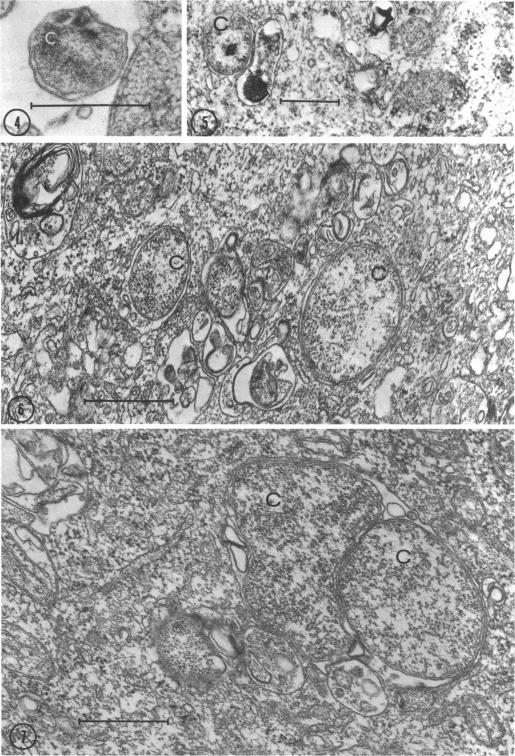
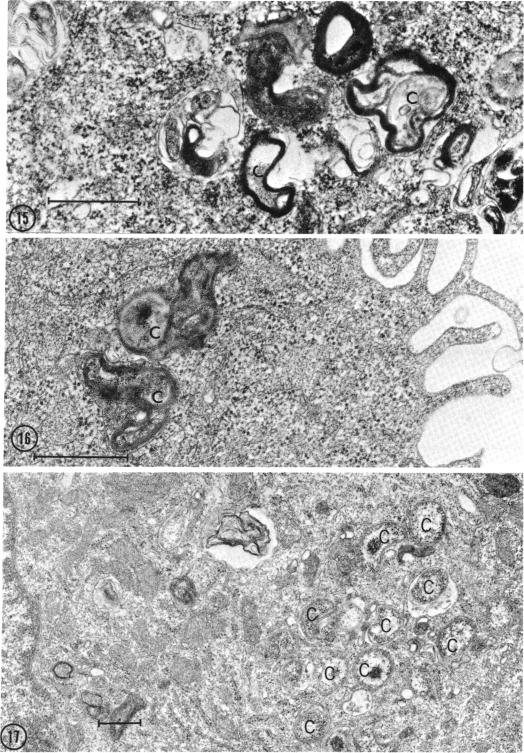
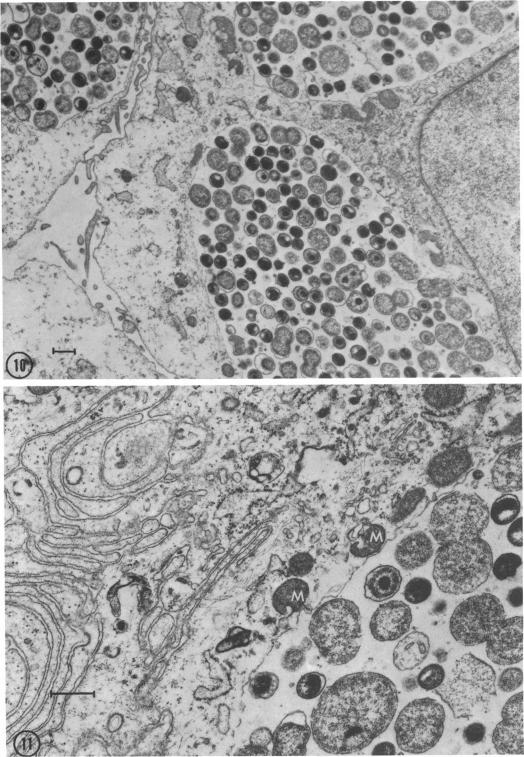
The entry and development of Chlamydia psittaci in the L cell was studied by using purified, infectious parasites at high multiplicity. Entry of the parasite was accomplished by an act of phagocytosis by the host which was independent of an adsorption stage but was temperature-dependent. Kinetic studies of phagocytosis performed with (14)C-amino acid-labeled, purified parasites indicated that the rate of phagocytosis was directly proportional to the multiplicity of inoculation. Electron microscopy of cells infected at high multiplicity with purified infectious C. psittaci showed that phagocytosed chlamydiae were segregated in a host phagocytic vacuole throughout their developmental cycle which consisted of the transition of infecting elementary bodies to reticulate bodies dividing by binary fission, followed by the reemergence of a population of elementary bodies. The process of the transition was examined and a proposed sequence of intermediate bodies is presented. In isopycnic gradients of fractionated, infected L cells, chlamydial phagocytic vacuoles were apparent as a dense band distinct from lysosome and mitochondrion peaks, as indicated by acid phosphatase and cytochrome oxidase activities. Chlamydiae inactivated by heat or neutralized by antiserum were phagocytosed and appeared in lysosomes within 12 hr after infection according to electron microscopy; however, chlamydiae which were continuously inhibited in their development by chloramphenicol were retained intact in the cell for 24 hr without lysosomal response. The possibility of a lysosomal inhibitor on the native parasite is discussed.
利用高感染复数的纯化感染性鹦鹉热衣原体,对其在L细胞中的侵入和发育进行了研究。该病原体的侵入是通过宿主的吞噬作用完成的,这一过程不依赖于吸附阶段,但依赖于温度。用(14)C -氨基酸标记的纯化病原体进行吞噬作用的动力学研究表明,吞噬速率与接种复数成正比。用纯化的感染性鹦鹉热衣原体高感染复数感染细胞的电子显微镜观察显示,吞噬的衣原体在其整个发育周期中都被隔离在宿主吞噬泡内,其发育周期包括感染性原体转变为通过二分裂进行分裂的网状体,随后出现一群原体。研究了转变过程,并提出了中间小体的推测序列。在分级分离的感染L细胞的等密度梯度中,衣原体吞噬泡表现为一条致密带,与溶酶体和线粒体峰明显不同,酸性磷酸酶和细胞色素氧化酶活性表明了这一点。根据电子显微镜观察,经加热灭活或被抗血清中和的衣原体在感染后12小时内被吞噬并出现在溶酶体内;然而,氯霉素持续抑制其发育的衣原体在细胞内完整保留24小时,未引起溶酶体反应。讨论了天然病原体上存在溶酶体抑制剂的可能性。