Lieberman M, Niwa O, Declève A, Kaplan H S
Proc Natl Acad Sci U S A. 1973 Apr;70(4):1250-3. doi: 10.1073/pnas.70.4.1250.
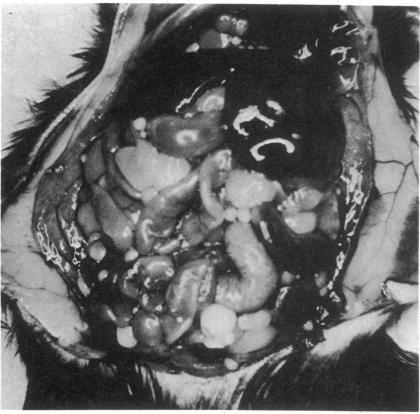
The radiation leukemia virus (RadLV), a murine leukemia virus derived from thymic lymphomas induced by x-irradiation in strain C57BL/Ka mice, has been successfully propagated in sustained high titer in vitro in a newly established line, BL-5, of C57BL/Ka mouse-embryo fibroblasts. In addition, the production of endogenous virus, presumed to be RadLV, has been induced and sustained through multiple serial passages after treatment of BL-5 cell cultures with 5-bromodeoxyuridine. The chronically RadLV-infected subline, designated BL-5 (RadLV), sheds virus into the supernatant culture fluids that is biologically active in vitro in the XC cell plaque assay, in interference assays for focus-formation by murine sarcoma virus, and in the intracellular induction of group-specific antigens detectable by immunofluorescence, but is apparently devoid of leukemogenic activity after intrathymic inoculation into neonatal or immunosuppressed C57BL/Ka mice. Although BL-5 cells exhibited morphological alterations suggestive of transformation in vitro and gave rise to fibrosarcomatous ascites tumors after intraperitoneal inoculation with C57BL/Ka mice, the chronically infected BL-5(RadLV) cells remained normal in morphology and failed to yield fibrosarcomas in vivo.
辐射白血病病毒(RadLV)是一种源自C57BL/Ka品系小鼠经X射线照射诱导的胸腺淋巴瘤的鼠白血病病毒,已在新建立的C57BL/Ka小鼠胚胎成纤维细胞系BL-5中成功地在体外持续高滴度繁殖。此外,在用5-溴脱氧尿苷处理BL-5细胞培养物后,通过多次连续传代诱导并维持了内源性病毒(推测为RadLV)的产生。长期感染RadLV的亚系,命名为BL-5(RadLV),可将病毒释放到上清培养液中,该病毒在XC细胞空斑试验、鼠肉瘤病毒聚焦形成的干扰试验以及通过免疫荧光可检测到的组特异性抗原的细胞内诱导试验中具有体外生物学活性,但在将其胸腺内接种到新生或免疫抑制的C57BL/Ka小鼠后显然没有致白血病活性。尽管BL-5细胞在体外表现出提示转化的形态学改变,并且在与C57BL/Ka小鼠进行腹腔接种后产生纤维肉瘤性腹水肿瘤,但长期感染的BL-5(RadLV)细胞在形态上保持正常,并且在体内未能产生纤维肉瘤。