Perper R J, Monovich R E, Van Gorder T J
Immunology. 1971 Dec;21(6):883-902.
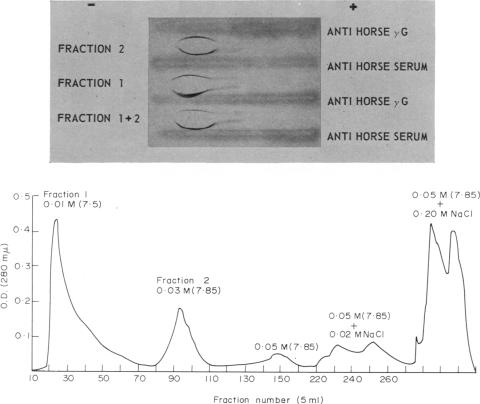
Two IgG subfractions of horse antilymphocyte serum (ALS) were obtained by DEAE Sephadex chromatography. Although the fractions did not differ antigenically, they differed on amino acid and carbohydrate analysis, and in electrophoretic mobility. As demonstrated by binding studies, only the most positively charged population of IgG molecules (fraction 1) obtained from anti-lymphocyte serum had specificity for the small lymphocyte; 50 per cent of the molecules in this population bound specifically to lymphocytes . As determined by an correlate of immunosuppressive potency (rosette inhibition), fraction 1 (F) IgG from ALS contained approximately 4 times the specific activity of fraction 2 (F). F was significantly more effective in prolonging skin graft survival than F, whereas F contained the major component of the non-specific anti-inflammatory activity of serum. The anti-inflammatory effect was mediated by anticomplement activity. F was found to be an effective inhibitor of the immunosuppressive activity of F both and . Quantitative studies indicated that 1 part of F could maximally inhibit 4 parts of F. The percentage of F present in serum IgG was inversely related to the skin graft survival elicited by the serum, which indicated that F was active as an inhibitor when tested as purified fraction as well as in unfractionated serum. Following immunization when F gained immunosuppressive potency, it lost non-specific anti-inflammatory activity. These observations indicated that not only was there a quantitative, as well as a qualitative concentration of immunosuppressive antibodies in F, but also that this activity was controlled by the concentration of F. This report, therefore, describes an IgG control mechanism which can limit the expression of antibody induced biological activity. It is suggested that in ALS the immunosuppressive antibody molecules possess a greater net positive charge than the remaining population, and that this is due to the degree of the negative charge on the immunizing antigen. Using DEAE Sephadex chromatography, these populations could be separated into two differently charged populations of molecules, only one of which had significant immunosuppressive capability. This increase in activity resulted from the increase of specific molecules, the loss of non-specific molecules, and was manifest upon the removal of an IgG inhibitor.
通过二乙氨基乙基葡聚糖凝胶(DEAE Sephadex)柱层析获得了马抗淋巴细胞血清(ALS)的两种IgG亚组分。虽然这两个亚组分在抗原性上没有差异,但在氨基酸和碳水化合物分析以及电泳迁移率方面存在差异。结合研究表明,从抗淋巴细胞血清中获得的带正电荷最多的IgG分子群体(组分1)对小淋巴细胞具有特异性;该群体中50%的分子能特异性结合淋巴细胞。通过免疫抑制效力的相关指标(玫瑰花结抑制)测定,ALS的组分1(F1)IgG的比活性约为组分2(F2)的4倍。F1在延长皮肤移植存活时间方面比F2显著更有效,而F2含有血清非特异性抗炎活性的主要成分。抗炎作用是由抗补体活性介导的。发现F1在体内和体外都是F2免疫抑制活性的有效抑制剂。定量研究表明,1份F1最多可抑制4份F2。血清IgG中F1所占的百分比与血清引起的皮肤移植存活呈负相关,这表明F1作为纯化组分以及在未分级血清中进行测试时均作为抑制剂具有活性。免疫后,当F1获得免疫抑制效力时,它失去了非特异性抗炎活性。这些观察结果表明,不仅F1中存在免疫抑制抗体的定量和定性浓度,而且这种活性受F2浓度的控制。因此,本报告描述了一种IgG控制机制,该机制可以限制抗体诱导的生物活性的表达。有人提出,在ALS中,免疫抑制抗体分子比其余群体具有更大的净正电荷,这是由于免疫抗原上负电荷的程度所致。使用DEAE Sephadex柱层析,这些群体可被分离成两个带不同电荷的分子群体,其中只有一个具有显著的免疫抑制能力。活性的增加是由于特异性分子的增加和非特异性分子的减少,并在去除一种IgG抑制剂后显现出来。