Cassingena R, Chany C, Vignal M, Suarez H, Estrade S, Lazar P
Proc Natl Acad Sci U S A. 1971 Mar;68(3):580-4. doi: 10.1073/pnas.68.3.580.
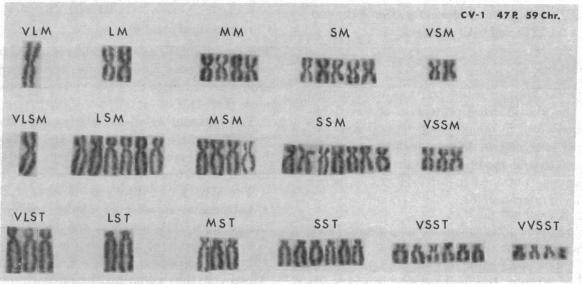
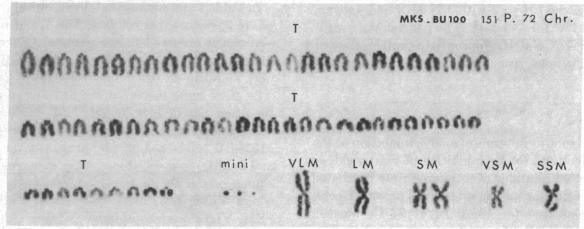
Four clones of a somatic monkey-mouse hybrid cell line were studied. One of these clones produced both mouse and monkey interferon, while the three others produced only mouse interferon. All four were, however, sensitive to both mouse and monkey (or human) interferon. The karyotype analysis of these four hybrid clones and the parental cell lines enabled us to locate the possible genetic site governing the synthesis of monkey interferon on a small subtelocentric monkey chromosome. The genetic site responsible for the synthesis of the antiviral protein is located on a different (monkey or mouse) chromosome.
对一个体细胞猴 - 鼠杂交细胞系的四个克隆进行了研究。其中一个克隆同时产生小鼠和猴干扰素,而其他三个只产生小鼠干扰素。然而,所有四个克隆对小鼠和猴(或人)干扰素都敏感。对这四个杂交克隆和亲本细胞系进行核型分析,使我们能够将控制猴干扰素合成的可能基因位点定位在一条小的亚端着丝粒猴染色体上。负责抗病毒蛋白合成的基因位点位于不同的(猴或鼠)染色体上。