Suppr超能文献

影响大脑皮质通路传导性的因素。

Factors affecting the conductivity of pathways in the cerebral cortex.

作者信息

Bliss T V, Burns B D, Uttley A M

出版信息

J Physiol. 1968 Mar;195(2):339-67. doi: 10.1113/jphysiol.1968.sp008462.

Abstract
  1. We have investigated the conductivity of neural pathways in slabs of unanaesthetized, isolated, cerebral cortex, cut from the isolated forebrains of twenty-five cats.2. Neurones within the isolated area were indirectly excited, either by a small electrode thrust into the subcortical white matter, or by remote stimulation of the pial surface. Sometimes a small electrode was employed for intracortical stimulation.3. The response of single neurones to these stimuli was recorded with extracellular micropipettes. Submaximal stimuli produced a stochastic response which was measured from the post-stimulus histogram (PSH) and provided an estimate of the probability of discharge at various times after the stimulus.4. The PSH often displayed several discrete humps of different latencies, indicating several pathways between stimulated and recording point. Conductivity measurements were usually restricted to the pathway of shortest latency.5. The conductivity of a pathway was defined as C = xy/x, averaged over 1 or 2 min, wherex = frequency of afferent test volleys,xy = frequency of response: i.e. of those action potentials contained within a well-defined hump of the PSH,(y = frequency of all discharges of the recorded neurone).6. The progress of conductivity was tested with some constant form of cortical stimulation, repeated at regular intervals of 1-5 sec. Reliable results were obtained for twenty-six pathways subjected to thirty-eight experiments.7. Temporary alteration of x, y or xy (conditioning with Deltax, Deltay or Deltaxy), for a period of 6-25 min, often caused a subsequent change in the conductivity (DeltaC) of a pathway which sometimes attenuated with a time constant of about 10 min, but which could persist without detectable attenuation for 20-30 min.8. Conditioning periods less than 6 min rarely produced changes in conductivity; alterations of conductivity were more likely to be caused by conditioning periods longer than 17 min, than by periods of 6-16 min.9. Changes in conductivity were usually correlatednegatively with temporary changes in xy,negatively with temporary changes in x,positively with temporary changes in y.10. Nineteen of twenty-six pathways tested showed properties consistent with the formula [Formula: see text], whereG(1) lies between -1.0 and -0.16, with mean value -0.50,G(2) lies between 0 and 0.42, with mean value +0.12,G(3) lies between -0.61 and 0 with mean value -0.38,K is a coefficient which is usually different for each experiment. Four out of twenty-six pathways so tested provided results which did not fit this formula; three out of twenty-six pathways did not give adequate information.
摘要
  1. 我们研究了从25只猫的离体前脑中切下的未麻醉、离体大脑皮质薄片中神经通路的传导性。

  2. 分离区域内的神经元通过插入皮质下白质的小电极或软脑膜表面的远距离刺激间接兴奋。有时也使用小电极进行皮质内刺激。

  3. 用细胞外微电极记录单个神经元对这些刺激的反应。阈下刺激产生随机反应,该反应从刺激后直方图(PSH)中测量,并提供刺激后不同时间放电概率的估计值。

  4. PSH通常显示几个不同潜伏期的离散峰,表明刺激点和记录点之间有几条通路。传导性测量通常限于最短潜伏期的通路。

  5. 通路的传导性定义为C = xy/x,在1或2分钟内平均,其中x = 传入测试脉冲的频率,xy = 反应频率:即PSH中明确峰内包含的动作电位频率,(y = 记录神经元所有放电的频率)。

  6. 用某种固定形式的皮质刺激测试传导性的变化,以1 - 5秒的固定间隔重复。对26条通路进行38次实验获得了可靠结果。

  7. 在6 - 25分钟内暂时改变x、y或xy(用Δx、Δy或Δxy进行条件化),常常会导致随后通路传导性(ΔC)的变化,这种变化有时以约10分钟的时间常数衰减,但也可能持续20 - 30分钟而无明显衰减。

  8. 少于6分钟的条件化期很少引起传导性变化;传导性变化更可能由超过17分钟的条件化期引起,而不是6 - 16分钟的条件化期。

  9. 传导性变化通常与xy 的暂时变化呈负相关,与x的暂时变化呈负相关,与y的暂时变化呈正相关。

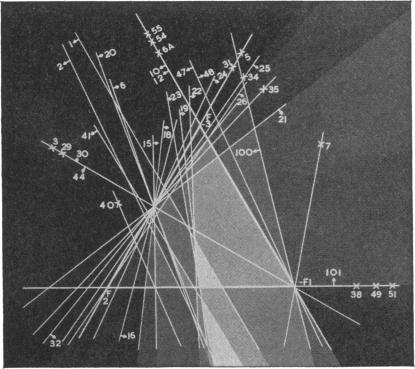
  10. 测试的26条通路中有19条显示出与公式[公式:见原文]一致的特性,其中G(1)在 - 1.0至 - 0.16之间,平均值为 - 0.50,G(2)在0至0.42之间,平均值为 + 0.12,G(3)在 - 0.61至0之间,平均值为 - 0.38,K是一个系数,每个实验通常不同。如此测试的26条通路中有4条提供的结果不符合该公式;26条通路中有3条未给出足够信息。
https://cdn.ncbi.nlm.nih.gov/pmc/blobs/abf7/1351667/23e48cd49974/jphysiol01105-0102-a.jpg

文献AI研究员

20分钟写一篇综述,助力文献阅读效率提升50倍。

立即体验

用中文搜PubMed

大模型驱动的PubMed中文搜索引擎

马上搜索

文档翻译

学术文献翻译模型,支持多种主流文档格式。

立即体验