
辐照珍宝蟹肉和太平洋牡蛎的微生物菌群。
Microbial flora of irradiated Dungeness crabmeat and Pacific oysters.
作者信息
Shiflett M A, Lee J S, Sinnhuber R O
出版信息
Appl Microbiol. 1966 May;14(3):411-5. doi: 10.1128/am.14.3.411-415.1966.
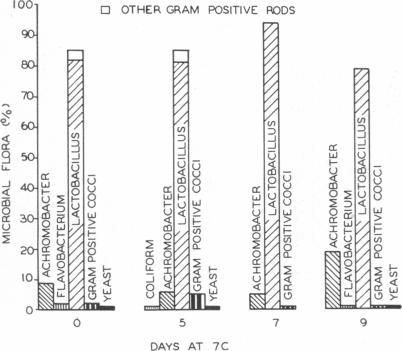
The microorganisms in Dungeness crabmeat (Cancer magister) and Pacific oysters (Crassostrea gigas) were identified by the replica-plating and computer analysis method. The initial flora of the shellfish and the flora change during storage at 7 C were determined. The microbial flora shifts in both shellfish were also determined after irradiation at 0.1 and 0.4 Mrad and during subsequent storage at 7 C. The Achromobacter species predominated in the initial flora of crabmeat (77.0%). The predominant position of this group increased to 99.2% after 0.1 Mrad and 100% after 0.4 Mrad. A large percentage of Lactobacillus was detected in oysters (55.0%). The Lactobacillus species were the predominant survivors after 0.1 Mrad (92.4%) but the predominant survivors after 0.4 Mrad were Achromobacter species (99.3%).
采用影印平板法和计算机分析方法对邓杰内斯蟹(Cancer magister)肉和太平洋牡蛎(Crassostrea gigas)中的微生物进行了鉴定。测定了贝类的初始菌群以及在7℃储存期间的菌群变化。还测定了在0.1和0.4兆拉德辐照后以及随后在7℃储存期间两种贝类中的微生物菌群变化。无色杆菌属在蟹肉的初始菌群中占主导地位(77.0%)。该菌群在0.1兆拉德辐照后占比升至99.2%,在0.4兆拉德辐照后占比达100%。在牡蛎中检测到大量乳酸杆菌(55.0%)。乳酸杆菌属是0.1兆拉德辐照后的主要存活菌(92.4%),但0.4兆拉德辐照后的主要存活菌是无色杆菌属(99.3%)。

 Zotero 插件