DeStephano D B, Lloyd R V, Pike A M, Wilson B S
Am J Pathol. 1984 Sep;116(3):464-72.
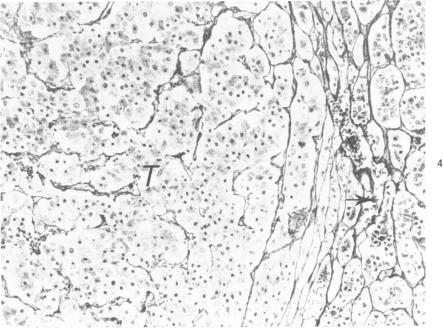
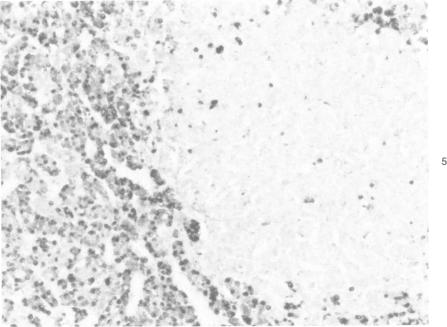
Tumors from 42 surgically resected pituitaries and from 13 autopsy cases were studied immunohistochemically with polyclonal antisera to 7 anterior pituitary hormones and with a newly developed monoclonal antibody directed against human chromogranin for evaluation of the distribution of chromogranin in normal and neoplastic pituitaries. In addition, a prospective study was done for assessment of the prevalence, morphology, and endocrine cell types of pituitary tumors in 100 autopsy subjects. When these 55 pituitary adenomas were examined with monoclonal antibody (LK2H10) directed against human chromogranin, selective staining of normal adenohypophyseal cell types and pituitary tumors was observed. Most null-cell adenomas (12/14) were positive for chromogranin, whereas all prolactin (PRL)-producing adenomas (19/19) were negative. Growth hormone (GH) adenomas were focally positive (9/9). All oncocytomas (2/2), 1 thyrotropin (TSH) adenoma, and a follicle-stimulating hormone/luteinizing hormone adenoma were positive for chromogranin. One or more adenomas were present in 14% of the autopsy cases. The tumors occurred most frequently in patients in the fifth through the seventh decades of life. Immunohistochemical staining of 13 adenomas revealed 1 TSH, 1 ACTH, and 4 PRL-producing tumors, whereas 7 other tumors, which were null-cell or undifferentiated adenomas, failed to stain for any of the seven principle pituitary hormones. These results indicate that antibody LK2H10 to human chromogranin is useful in the immunohistochemical characterization of pituitary adenomas. Incidental pituitary microadenomas from autopsy-derived pituitaries most commonly produce PRL, or they belong to the null-cell or undifferentiated tumor group.
对42例手术切除的垂体肿瘤以及13例尸检病例的垂体进行免疫组织化学研究,使用针对7种垂体前叶激素的多克隆抗血清以及一种新开发的针对人嗜铬粒蛋白的单克隆抗体,以评估嗜铬粒蛋白在正常和肿瘤性垂体中的分布。此外,还进行了一项前瞻性研究,以评估100例尸检对象中垂体肿瘤的患病率、形态和内分泌细胞类型。当用针对人嗜铬粒蛋白的单克隆抗体(LK2H10)检测这55例垂体腺瘤时,观察到正常腺垂体细胞类型和垂体肿瘤的选择性染色。大多数无功能细胞腺瘤(12/14)嗜铬粒蛋白呈阳性,而所有分泌催乳素(PRL)的腺瘤(19/19)均为阴性。生长激素(GH)腺瘤呈局灶性阳性(9/9)。所有嗜酸性细胞瘤(2/2)、1例促甲状腺激素(TSH)腺瘤以及1例促卵泡激素/黄体生成素腺瘤嗜铬粒蛋白均呈阳性。14%的尸检病例中存在一个或多个腺瘤。这些肿瘤最常见于50到70岁的患者。对13例腺瘤进行免疫组织化学染色显示,有1例TSH、1例促肾上腺皮质激素(ACTH)和4例分泌PRL的肿瘤,而其他7例肿瘤为无功能细胞或未分化腺瘤,对七种主要垂体激素均未染色。这些结果表明,针对人嗜铬粒蛋白的抗体LK2H10在垂体腺瘤的免疫组织化学特征鉴定中很有用。尸检垂体中偶然发现的垂体微腺瘤最常分泌PRL,或者属于无功能细胞或未分化肿瘤组。