Hampl H, Ben-Porat T, Ehrlicher L, Habermehl K O, Kaplan A S
J Virol. 1984 Nov;52(2):583-90. doi: 10.1128/JVI.52.2.583-590.1984.
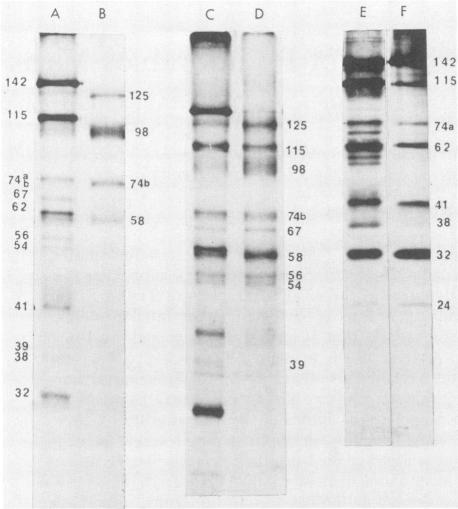
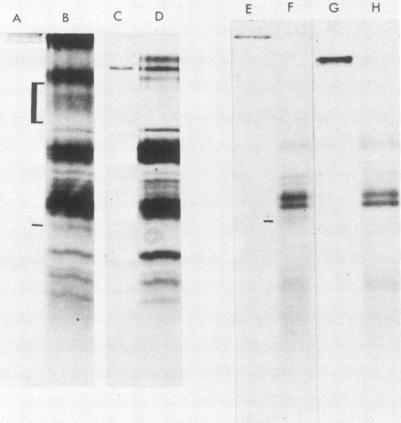
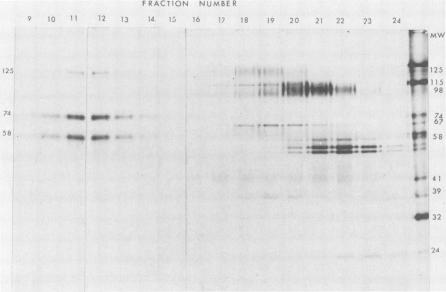
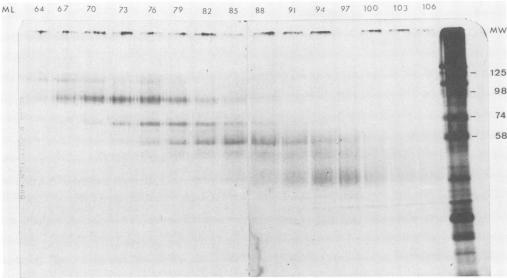
Previously we have reported that among the proteins of purified pseudorabies virions there are four major glycoproteins (T. Ben-Porat and A. S. Kaplan, Virology 41:265-273, 1970). Several minor glycoproteins can also be identified by two-dimensional gel electrophoresis. Removal of the viral envelope with Triton X-100 selectively removes from the virions all of the glycoproteins as well as several non-glycosylated proteins. Sedimentation analysis or chromatography of these proteins reveals that several are complexed with one another, some being covalently linked via disulfide bridges. Analysis of the proteins by immunoprecipitation with monoclonal antibodies reactive with the membrane proteins showed also that three of the four major virus glycoproteins (125K, 74K, and 58K; gIIa, gIIb, and gIIc, respectively) are linked covalently by disulfide bridges. Furthermore, all three share extensive sequence homology as indicated by the identity of their antigenic determinants and by partial peptide mapping; they probably originate from a single protein precursor. The fourth major glycoprotein (98K; gIII) is not complexed to any other protein. Three minor glycoproteins (130K [gI], 98K [gIV], and 62K [gV]), which form a noncovalently linked complex with a 115K nonglycosylated protein, have also been identified. Of the monoclonal antibodies used in this study, only those reactive with the major 98K glycoprotein (gIII) inhibit virus adsorption and neutralize virus infectivity in the absence of complement. However, all react with surface components of the virion, indicating that the proteins with which they react are exposed on the surface of the virions. A nomenclature for the pseudorabies virus glycoproteins is proposed.
此前我们曾报道,在纯化的伪狂犬病病毒粒子的蛋白质中,有四种主要糖蛋白(T. 本 - 波拉特和A. S. 卡普兰,《病毒学》41:265 - 273,1970)。通过二维凝胶电泳也可鉴定出几种次要糖蛋白。用Triton X - 100去除病毒包膜可选择性地从病毒粒子中去除所有糖蛋白以及几种非糖基化蛋白。对这些蛋白质进行沉降分析或色谱分析表明,其中几种相互复合,有些通过二硫键共价连接。用与膜蛋白反应的单克隆抗体对蛋白质进行免疫沉淀分析还表明,四种主要病毒糖蛋白中的三种(分别为125K、74K和58K;即gIIa、gIIb和gIIc)通过二硫键共价连接。此外,正如它们抗原决定簇的一致性和部分肽图谱所示,这三种糖蛋白具有广泛的序列同源性;它们可能起源于单一蛋白质前体。第四种主要糖蛋白(98K;gIII)不与任何其他蛋白质复合。还鉴定出三种次要糖蛋白(130K [gI]、98K [gIV]和62K [gV]),它们与一种115K的非糖基化蛋白形成非共价连接的复合物。在本研究中使用的单克隆抗体中,只有那些与主要的98K糖蛋白(gIII)反应的抗体在没有补体的情况下能抑制病毒吸附并中和病毒感染性。然而,所有抗体都与病毒粒子的表面成分反应,表明它们所反应的蛋白质暴露在病毒粒子表面。本文提出了伪狂犬病病毒糖蛋白的命名法。