Rottier P J, Horzinek M C, van der Zeijst B A
J Virol. 1981 Nov;40(2):350-7. doi: 10.1128/JVI.40.2.350-357.1981.
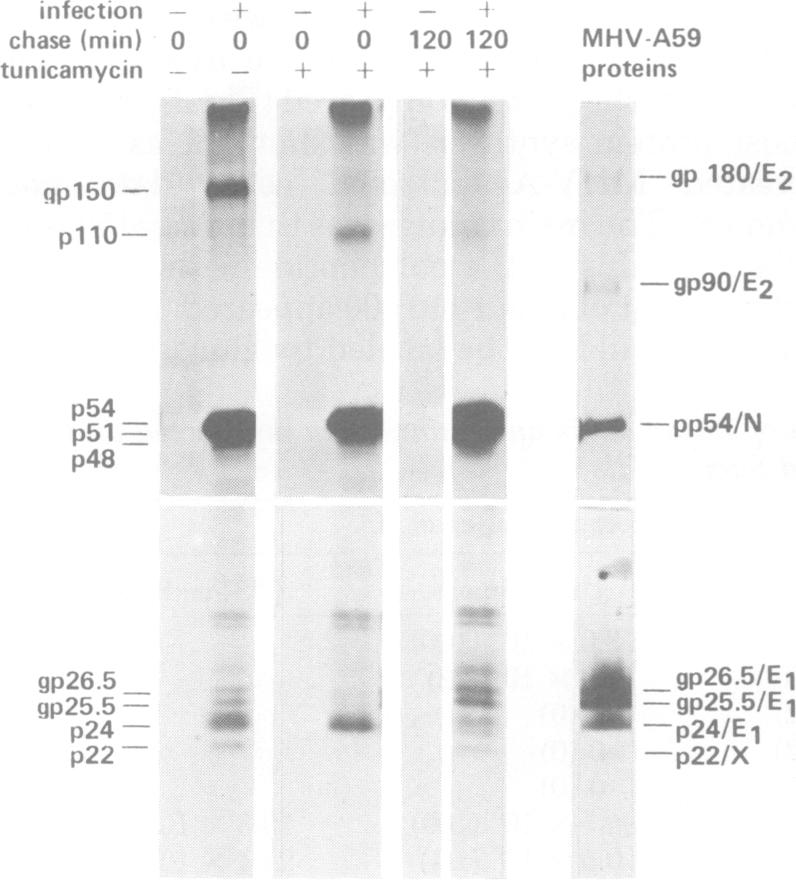
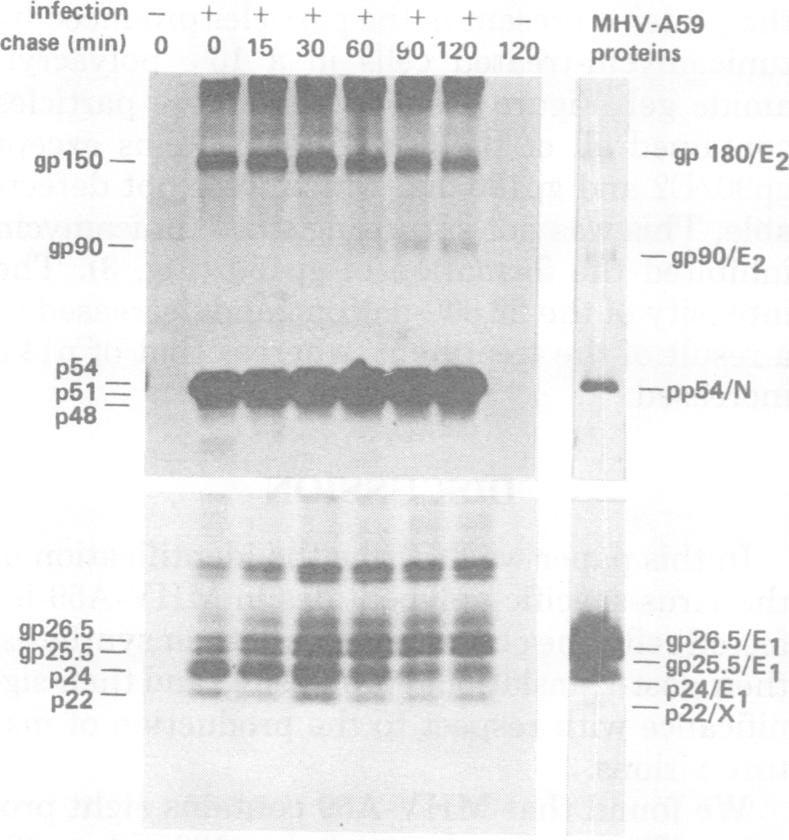
We identified eight protein species in virions of mouse hepatitis virus strain A59. Based on their sizes, prosthetic groups, and locations in virions, these proteins were designated gp180/E2, gp90/E2, pp54/N, gp26.5/E1, gp25.5/E1, p24/E1, p22/X, and p14.5/Y. The positions of the last two proteins in virions are not known. Host protein synthesis in Sac(-) cells infected with mouse hepatitis virus strain A59 was inhibited, and the following novel proteins appeared: gp150, gp90, p54, gp26.5, gp25.5, p24, p22, and p14.5. Except for gp150, these polypeptides all co-electrophoresed with mouse hepatitis virus strain A59 structural proteins. In addition, all of these proteins could be immunoprecipitated with a convalescent mouse serum or a rabbit antiserum raised against purified disrupted virus. After a 15-min pulse of infected cells with radioactive amino acids at 7h postinfection, gp90 was not detected, whereas gp26.5 and gp25.5 were only labeled to a small extent. During a subsequent chase period gp150 was processed to gp90, whereas the radioactivity in gp26.5 and gp25.5 increased concomitantly with a reduction of label in p24. Tunicamycin, an antibiotic which inhibits the synthesis of glycopeptides bearing N glycosidically linked oligosaccharides, prevented the appearance of gp150 in mouse hepatitis virus strain A59-infected cells. Instead, a 110,000-dalton protein accumulated. In contrast, the syntheses of the smaller viral glycoproteins gp26.5 and gp25.5 were resistant to this drug, indicating that these glycosylations were of the O glycosidical type. Although the production of infectious virus in tunicamycin-treated cells was inhibited by more than 99%, release of noninfectious viral particles continued. An analysis of these particles revealed that they lacked the peplomeric glycoproteins gp90/E2 and gp180/E2. Obviously, although the surface projections were not essential for budding of virus particles from the cells, they were required for infectivity.
我们在小鼠肝炎病毒A59株的病毒粒子中鉴定出了8种蛋白质。根据它们的大小、辅基以及在病毒粒子中的位置,这些蛋白质被命名为gp180/E2、gp90/E2、pp54/N、gp26.5/E1、gp25.5/E1、p24/E1、p22/X和p14.5/Y。后两种蛋白质在病毒粒子中的位置尚不清楚。感染小鼠肝炎病毒A59株的Sac(-)细胞中的宿主蛋白合成受到抑制,并且出现了以下新蛋白质:gp150、gp90、p54、gp26.5、gp25.5、p24、p22和p14.5。除了gp150外,这些多肽都与小鼠肝炎病毒A59株的结构蛋白共电泳。此外,所有这些蛋白质都可以用恢复期小鼠血清或针对纯化的破碎病毒产生的兔抗血清进行免疫沉淀。在感染后7小时用放射性氨基酸对感染细胞进行15分钟的脉冲标记后,未检测到gp90,而gp26.5和gp25.5仅被少量标记。在随后的追踪期内,gp150被加工成gp90,而gp26.5和gp25.5中的放射性随着p24中标记的减少而同时增加。衣霉素是一种抑制带有N-糖苷连接寡糖的糖肽合成的抗生素,它阻止了gp150在感染小鼠肝炎病毒A59株的细胞中出现。相反,一种110,000道尔顿的蛋白质积累了下来。相比之下,较小的病毒糖蛋白gp26.5和gp25.5的合成对这种药物具有抗性,表示这些糖基化是O-糖苷类型。尽管在衣霉素处理的细胞中感染性病毒的产生被抑制了99%以上,但非感染性病毒颗粒的释放仍在继续。对这些颗粒的分析表明,它们缺乏包膜糖蛋白gp90/E2和gp180/E2。显然,虽然表面突起对于病毒颗粒从细胞中出芽不是必需的,但它们对于感染性是必需的。