Hruby D E, Maki R A, Miller D B, Ball L A
Proc Natl Acad Sci U S A. 1983 Jun;80(11):3411-5. doi: 10.1073/pnas.80.11.3411.
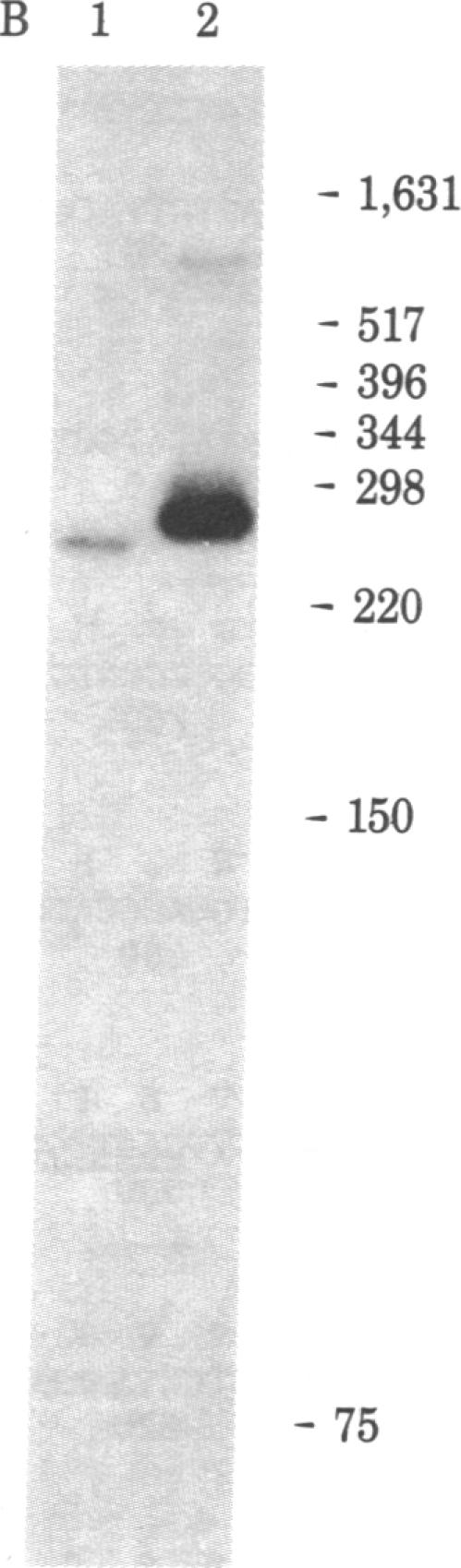
The thymidine kinase (ATP:thymidine 5'-phosphotransferase, EC 2.7.1.21) gene of vaccinia virus has previously been mapped near the middle of the viral DNA, within the 4.85-kilobase HindIII J fragment, and shown to encode a Mr 19,000 polypeptide [Hruby, D. E. & Ball, L. A. (1982) J. Virol. 43, 403-409]. To locate the gene more precisely and to determine the structure of the basic transcriptional unit, the positions of cleavage sites for several restriction endonucleases were mapped within the HindIII J DNA fragment. Four appropriate subfragments of HindIII J DNA were inserted into plasmid pBR322 derivatives and cloned in Escherichia coli. These recombinant plasmid DNAs were tested for their ability to inhibit the cell-free synthesis of active thymidine kinase and to retain the mRNA for this enzyme when immobilized on nitrocellulose filters. The data showed that the gene spanned an EcoRI cleavage site that lies 850 base pairs from the left-hand end of the HindIII J fragment (the HindIII L-J boundary). Because hybridization of vaccinia virus DNA to partially purified thymidine kinase mRNA detected only a single 670-nucleotide RNA species capable of hybridizing to this region of the genome, nuclease S1 mapping experiments were carried out with thymidine kinase mRNA to protect DNA fragments that were terminally labeled at this EcoRI site. The results indicated that the gene extended from about 550 to 1,150 base pairs from the left end of HindIII J, was transcribed in a rightward direction, and contained no intervening sequences. Hence, a 1.04-kilobase Ava II-Hpa II restriction fragment containing this region of DNA was isolated and subjected to nucleotide sequence analysis. An examination of this nucleotide sequence revealed the presence of an open reading frame of 531 nucleotides capable of encoding a protein of 177 amino acids with a Mr of 20,077.
痘苗病毒的胸苷激酶(ATP:胸苷5'-磷酸转移酶,EC 2.7.1.21)基因先前已定位在病毒DNA中部附近,位于4.85千碱基的HindIII J片段内,并显示编码一种分子量为19,000的多肽[赫鲁比,D. E. & 鲍尔,L. A.(1982年)《病毒学杂志》43卷,403 - 409页]。为了更精确地定位该基因并确定基本转录单位的结构,在HindIII J DNA片段内绘制了几种限制性内切酶的切割位点位置。将HindIII J DNA的四个合适亚片段插入质粒pBR322衍生物中,并在大肠杆菌中克隆。测试这些重组质粒DNA抑制无细胞体系中活性胸苷激酶合成的能力,以及固定在硝酸纤维素滤膜上时保留该酶mRNA的能力。数据表明,该基因跨越一个EcoRI切割位点,该位点距HindIII J片段左端(HindIII L - J边界)850个碱基对。由于痘苗病毒DNA与部分纯化的胸苷激酶mRNA杂交仅检测到一种能够与基因组该区域杂交的670个核苷酸的RNA种类,因此用胸苷激酶mRNA进行核酸酶S1定位实验,以保护在该EcoRI位点进行末端标记的DNA片段。结果表明,该基因从HindIII J左端约550个碱基对延伸至1150个碱基对,向右转录,且不包含间隔序列。因此,分离出一个包含该DNA区域的1.04千碱基的Ava II - Hpa II限制性片段,并进行核苷酸序列分析。对该核苷酸序列的检查揭示了一个531个核苷酸的开放阅读框,能够编码一个由177个氨基酸组成、分子量为20,077的蛋白质。