Van Doren K, Hanahan D, Gluzman Y
J Virol. 1984 May;50(2):606-14. doi: 10.1128/JVI.50.2.606-614.1984.
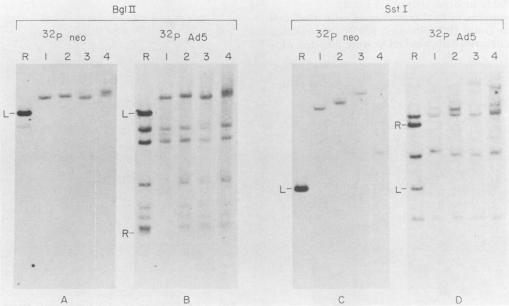
Recombinant viral genomes carrying a selectable drug resistance marker have been constructed by insertion of a hybrid gene for neomycin resistance into the helper-independent adenovirus vector, delta E1/X. The hybrid gene consists of sequences coding for the aminoglycoside 3'-phosphotransferase II from Tn5, under the control of the simian virus 40 early promoter, and renders mammalian cells resistant to the neomycin analog, G-418. Most of adenovirus early region 1 is deleted from delta E1/X (nucleotides 455 to 3330), and recombinant viral genomes carry the hybrid gene in its place. The large and small XbaI fragments of delta E1/X were ligated to the hybrid gene, and the mixture was transfected into 293 cells. Single plaques were isolated and subsequently passaged in 293 cells to produce virus stocks. The recombinant viruses efficiently rendered cultured rat (Rat2) and simian (CV1) cells resistant to G-418. Cloned cell lines selected for resistance to G-418 contained viral DNA integrated into the host cell genome, demonstrating that early region 1 is not essential for integration of the viral genome. Southern transfer experiments revealed that (i) the sites of integration in the host genome were not unique; (ii) in general, transformed CV1 cell lines contained single-copy, full-length viral genomes, colinear with the infecting virus; (iii) transformed Rat2 cell lines generally contained one to several copies of full-length viral genomes integrated colinearly with the infecting viral DNA; and (iv) three of these five lines of transformed Rat2 cell lines contained tandemly repeated viral DNA sequences in which the right and left ends of the viral genome were joined to each other.
通过将新霉素抗性杂交基因插入到无辅助病毒的腺病毒载体delta E1/X中,构建了携带可选择药物抗性标记的重组病毒基因组。该杂交基因由在猴病毒40早期启动子控制下编码来自Tn5的氨基糖苷3'-磷酸转移酶II的序列组成,使哺乳动物细胞对新霉素类似物G-418产生抗性。delta E1/X中大部分腺病毒早期区域1被删除(核苷酸455至3330),重组病毒基因组在其位置携带杂交基因。将delta E1/X的大、小XbaI片段与杂交基因连接,然后将混合物转染到293细胞中。分离出单个噬斑,随后在293细胞中传代以产生病毒株。重组病毒有效地使培养的大鼠(Rat2)和猴(CV1)细胞对G-418产生抗性。选择对G-418有抗性的克隆细胞系含有整合到宿主细胞基因组中的病毒DNA,表明早期区域1对于病毒基因组的整合不是必需的。Southern印迹实验表明:(i)宿主基因组中的整合位点并非唯一;(ii)一般来说,转化的CV1细胞系含有单拷贝、全长病毒基因组,与感染病毒共线性;(iii)转化的Rat2细胞系通常含有一至几个全长病毒基因组拷贝,与感染的病毒DNA共线性整合;(iv)这五个转化的Rat2细胞系中的三个含有串联重复的病毒DNA序列,其中病毒基因组的右端和左端相互连接。