Chalovich J M, Eisenberg E
J Biol Chem. 1982 Mar 10;257(5):2432-7.
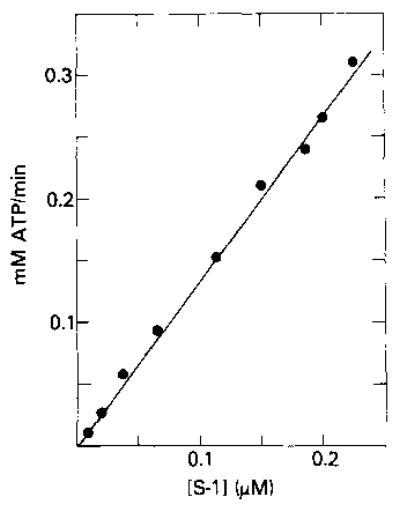
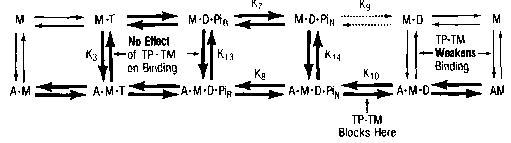
Relaxation of vertebrate skeletal muscle is thought to occur in the absence of Ca as a result of tropomyosin physically blocking the binding of myosin to actin. This steric blocking model of muscle relaxation predicts that myosin subfragment 1 (S-1) will not bind to actin under conditions where the acto-S-1 ATPase rate is inhibited. Using stopped flow absorbance as a measure of binding, we have previously shown that when the rate of ATP hydrolysis is only 4% of the rate in the presence of Ca, S-1·ATP and S-1·ADP·P bind to actin-troponin-tropomyosin (regulated actin) with almost the same affinity as in the presence of Ca. This result has now been confirmed using sedimentation in an air-driven ultracentrifuge to directly measure the binding at pH 7.0, 25 °C, and μ = 18 mm. In the presence of Ca, the rate of ATP hydrolysis is more than 20 times greater than in the absence of Ca. In contrast, the association constant of S-1·ATP and S-1·ADP·P with regulated actin is virtually the same in the absence of Ca (1.4 × 10 m) as in the presence of Ca (1.5 × 10 m). Similarly, at 50 mm ionic strength, the ATPase rate is inhibited about 98% in the absence of Ca although the association constant is not significantly changed compared to that in the presence of Ca. Finally, it has been shown that, at 18 mm ionic strength, the inhibition of the actin-activated ATPase rate in the absence of Ca is due to a large decrease in the maximum ATPase rate (to 4% of the Ca value) with only a small change in the apparent binding constant of S-1 to actin. These data do not support a simple steric blocking model of muscle relaxation. Rather they suggest that, in the absence of Ca, troponin-tropomyosin inhibits a kinetic step, perhaps P release, in the cycle of ATP hydrolysis.
脊椎动物骨骼肌的舒张被认为是在没有钙离子的情况下发生的,这是由于原肌球蛋白物理性地阻止了肌球蛋白与肌动蛋白的结合。这种肌肉舒张的空间位阻模型预测,在肌动蛋白-肌球蛋白亚片段1(S-1)ATP酶速率受到抑制的条件下,肌球蛋白亚片段1不会与肌动蛋白结合。我们之前使用停流吸光度作为结合的测量方法,已经表明当ATP水解速率仅为有钙离子存在时速率的4%时,S-1·ATP和S-1·ADP·P与肌动蛋白-肌钙蛋白-原肌球蛋白(调节型肌动蛋白)结合的亲和力与有钙离子存在时几乎相同。现在,通过在气动超速离心机中沉降以直接测量在pH 7.0、25℃和μ = 18 mM条件下的结合情况,这一结果得到了证实。在有钙离子存在时,ATP水解速率比没有钙离子时快20多倍。相比之下,S-1·ATP和S-1·ADP·P与调节型肌动蛋白的缔合常数在没有钙离子(1.4×10⁷ M⁻¹)和有钙离子(1.5×10⁷ M⁻¹)时几乎相同。同样,在离子强度为50 mM时,在没有钙离子的情况下ATP酶速率被抑制约98%,尽管缔合常数与有钙离子时相比没有显著变化。最后,已经表明,在离子强度为18 mM时,在没有钙离子的情况下肌动蛋白激活的ATP酶速率受到抑制是由于最大ATP酶速率大幅下降(降至有钙离子时值的4%),而S-1与肌动蛋白的表观结合常数仅有微小变化。这些数据不支持简单的肌肉舒张空间位阻模型。相反,它们表明,在没有钙离子的情况下,肌钙蛋白-原肌球蛋白在ATP水解循环中抑制了一个动力学步骤,可能是磷酸释放。