Carlsson L, Lazarides E
Proc Natl Acad Sci U S A. 1983 Aug;80(15):4664-8. doi: 10.1073/pnas.80.15.4664.
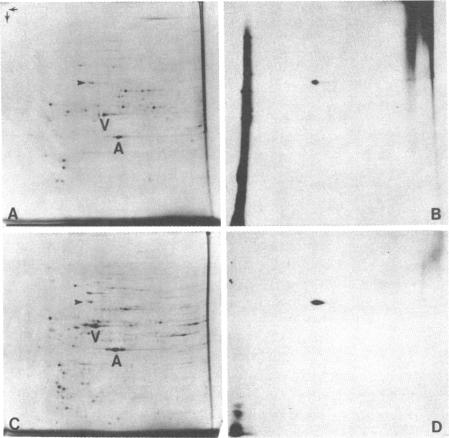
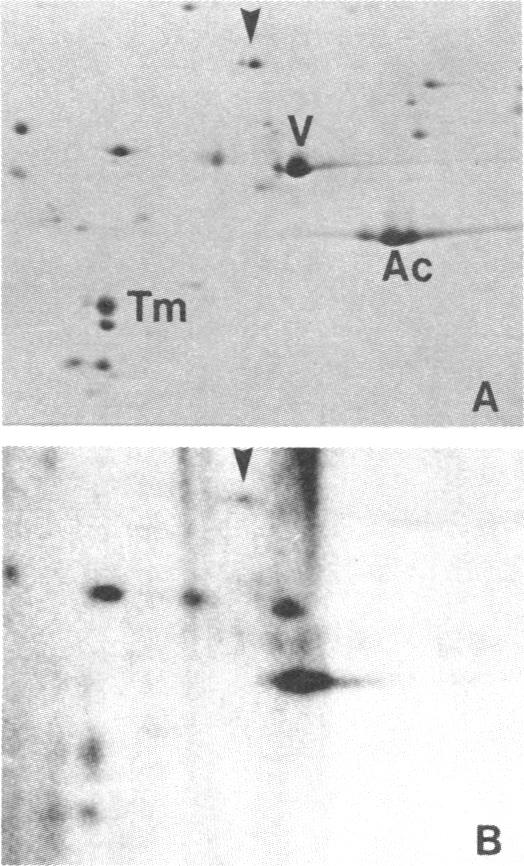
ADP-ribosylation of proteins was analyzed by in vivo labeling of cells with [3H]adenosine, followed by separation of their protein components by two-dimensional isoelectric focusing/NaDodSO4 polyacrylamide gel electrophoresis. We show here that in several cell types of avian and mammalian origin the major [34H]adenosine acceptor in vivo is a polypeptide with a Mr of 83,000 and isoelectric point of approximately equal to 5.3. This polypeptide is identical to one of the stress-inducible and glucose-regulated proteins (here called SP83) previously described in avian and mammalian cells. Snake venom phosphodiesterase digestion of purified 3H-labeled SP83 releases 5'-AMP and a minor fraction of 2'-(5"-phosphoribosyl)-5-AMP. In vitro labeling with [32P]NAD+ of total cell lysates made in the presence of non-ionic detergents also results in incorporation of radioactivity into SP83. Both of these results strongly suggest that the modification is an ADP-ribosylation. Heat shock and glucose starvation of cells induce a rapid and extensive decrease in the incorporation of ADP-ribose into SP83, suggesting that ADP-ribosylation may be important for the regulation of the function of this protein.
通过用[3H]腺苷对细胞进行体内标记,然后通过二维等电聚焦/十二烷基硫酸钠聚丙烯酰胺凝胶电泳分离其蛋白质成分,来分析蛋白质的ADP-核糖基化。我们在此表明,在几种鸟类和哺乳动物来源的细胞类型中,体内主要的[3H]腺苷受体是一种分子量为83,000、等电点约为5.3的多肽。这种多肽与先前在鸟类和哺乳动物细胞中描述的一种应激诱导和葡萄糖调节蛋白(此处称为SP83)相同。用蛇毒磷酸二酯酶消化纯化的3H标记的SP83会释放5'-AMP和一小部分2'-(5"-磷酸核糖基)-5-AMP。在非离子去污剂存在下制备的总细胞裂解物用[32P]NAD+进行体外标记,也会导致放射性掺入SP83。这两个结果都强烈表明该修饰是ADP-核糖基化。细胞的热休克和葡萄糖饥饿会导致ADP-核糖掺入SP83的量迅速且大幅减少,这表明ADP-核糖基化可能对该蛋白质功能的调节很重要。