Kinouchi T, Ohnishi Y
Appl Environ Microbiol. 1983 Sep;46(3):596-604. doi: 10.1128/aem.46.3.596-604.1983.
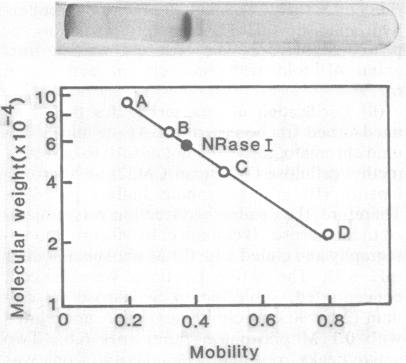
We isolated four nitroreductases from Bacteroides fragilis GAI0624 and examined their physicochemical and functional properties. Two major enzyme activities were found in the adsorbed and unadsorbed fractions from DEAE-cellulose column chromatography. The adsorbed fraction was subjected to Sephadex G-200 column chromatography, and two further activities were separated. One has high nitroreductase activity (nitroreductase I), and the other has low activity and relatively high molecular weight (nitroreductase III). The nitroreductase I fraction was subjected to hydroxylapatite and chromatofocusing column chromatography, and nitroreductase I was purified about 416-fold with a yield of 6.77%. The unadsorbed fraction from DEAE-cellulose column chromatography was subjected to Sepharose 2B and Sepharose 6B column chromatography. Two enzyme activities were obtained by the Sepharose 6B column chromatography. One has high activity (nitroreductase II), and the other has low activity (nitroreductase IV). Nitroreductase II was rechromatographed by Sepharose 6B gel filtration and purified about 178-fold with a yield of 9.65%. The four enzymes (nitroreductases I, II, III, and IV) were shown to be different by several criteria. Their molecular weights, determined by gel filtration, were 52,000, 320,000, 180,000, and 680,000, respectively. The substrate specificity, the effect on mutagenicity of mutagenic nitro compounds, of nitroreductases I, III, and IV was relatively high for 1-nitropyrene, dinitropyrenes, and 4-nitroquinoline 1-oxide, respectively, but nitroreductase II had broad specificity. Nitroreductase activity required a coenzyme; nitroreductases II, III, and IV were NADPH linked, but nitroreductase I was NADH linked. All enzyme activity was enhanced by addition of flavin mononucleotide and inhibited significantly by dicumarol, p-chloromercuribenzoic acid, o-iodosobenzoic acid, sodium azide, and Cu2+.(ABSTRACT TRUNCATED AT 250 WORDS)
我们从脆弱拟杆菌GAI0624中分离出四种硝基还原酶,并检测了它们的理化性质和功能特性。在DEAE-纤维素柱层析的吸附和未吸附组分中发现了两种主要的酶活性。对吸附组分进行Sephadex G-200柱层析,又分离出另外两种活性。一种具有高硝基还原酶活性(硝基还原酶I),另一种活性低且分子量相对较大(硝基还原酶III)。对硝基还原酶I组分进行羟基磷灰石柱层析和聚焦柱层析,硝基还原酶I纯化了约416倍,产率为6.77%。将DEAE-纤维素柱层析的未吸附组分进行Sepharose 2B和Sepharose 6B柱层析。通过Sepharose 6B柱层析获得了两种酶活性。一种具有高活性(硝基还原酶II),另一种活性低(硝基还原酶IV)。硝基还原酶II通过Sepharose 6B凝胶过滤重新层析,纯化了约178倍,产率为9.65%。这四种酶(硝基还原酶I、II、III和IV)在几个标准上表现不同。通过凝胶过滤测定它们的分子量分别为52,000、320,000、180,000和680,000。硝基还原酶I、III和IV对底物的特异性,对致突变性硝基化合物致突变性的影响,分别对1-硝基芘、二硝基芘和4-硝基喹啉1-氧化物相对较高,但硝基还原酶II具有广泛的特异性。硝基还原酶活性需要辅酶;硝基还原酶II、III和IV与NADPH相连,但硝基还原酶I与NADH相连。添加黄素单核苷酸可增强所有酶活性,而双香豆素、对氯汞苯甲酸、邻碘苯甲酸、叠氮化钠和Cu2+可显著抑制酶活性。(摘要截短于250字)