Seggev J, Goren M B, Carr R I, Kirkpatrick C H
Am J Pathol. 1982 Mar;106(3):348-55.
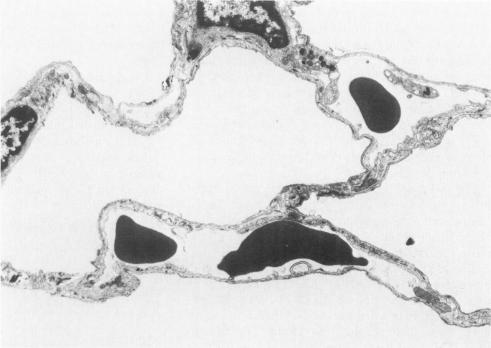
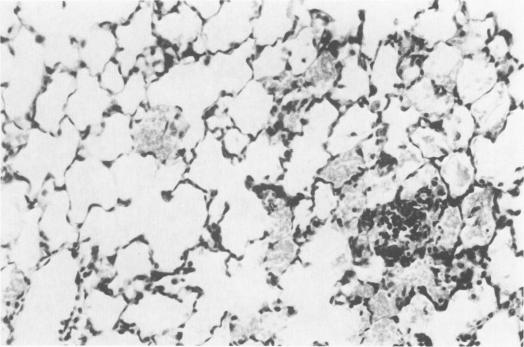
Intraperitoneal injections of cord factor (trehalose dimycolate, TDM) provides a model for interstitial and hemorrhagic lung disease that is produced by a chemically defined substance. A single injection of 10 micrograms of TDM, in light mineral oil or hexadecane, into C57BL/6 mice produces interstitial and hemorrhagic pneumonitis. Following injection of TDM the pulmonary lesions increase gradually and become maximal by the seventh to ninth day, at which time 70% of the mice show both gross hemorrhages and dense mononuclear infiltrates; an additional 20% of the mice show only microscopic lesions. From day 14 onward the incidence and severity of the lesions decrease, and by day 28 the lungs are normal by both gross and light-microscopy examination. Only 5% of the mice succumb. Except for peritonitis other organs are not affected. Doses of 3.3 and 10 micrograms of TDM are equally effective in producing the lesions, but a dose of 1.0 microgram of TDM causes only mild interstitial inflammation and lesser doses do not induce lesions. A single subcutaneous injection of 10 micrograms of TDM causes lesions in only 20% of mice. Vehicle-injected mice do not develop lesions. Electron microscopy revealed that the majority of the infiltrating cells are monocytes and macrophages and that extensive interstitial damage is produced. The mechanism of the effects of TDM are unknown and is currently under study. Our preliminary data suggests that the phenomenon is dependent upon T-lymphocytes.
腹腔注射索状因子(海藻糖二霉菌酸酯,TDM)可提供一种由化学定义物质引起的间质性和出血性肺病模型。将10微克TDM溶解在轻质矿物油或十六烷中,单次注射到C57BL/6小鼠体内,可产生间质性和出血性肺炎。注射TDM后,肺部病变逐渐增加,在第7至9天达到最大值,此时70%的小鼠出现肉眼可见的出血和密集的单核细胞浸润;另外20%的小鼠仅表现为显微镜下的病变。从第14天起,病变的发生率和严重程度开始下降,到第28天,通过大体和光学显微镜检查,肺部均恢复正常。只有5%的小鼠死亡。除腹膜炎外,其他器官未受影响。3.3微克和10微克的TDM剂量在产生病变方面同样有效,但1.0微克的TDM剂量仅引起轻度间质性炎症,更小的剂量则不会诱发病变。单次皮下注射10微克TDM仅在20%的小鼠中引起病变。注射赋形剂的小鼠未出现病变。电子显微镜显示,大多数浸润细胞为单核细胞和巨噬细胞,并且产生了广泛的间质损伤。TDM作用的机制尚不清楚,目前正在研究中。我们的初步数据表明,这种现象依赖于T淋巴细胞。