Alt F W, Rosenberg N, Enea V, Siden E, Baltimore D
Mol Cell Biol. 1982 Apr;2(4):386-400. doi: 10.1128/mcb.2.4.386-400.1982.
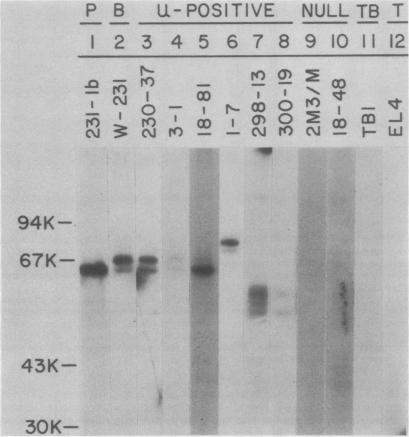
Lymphoid cells transformed by Abelson murine leukemia virus (A-MuLV) contain three classes of RNA transcripts from immunoglobulin mu genes. P mu-mRNAs (productive) correspond to the normal 2.7-kilobase (kb) membrane (mu m) and 2.4-kb secreted (mu s) mu mRNA species both in size and coding capacity and occur at approximately equal abundance in most mu-positive (pre-B-like) A-MuLV transformants. A mu-mRNAs (aberrant) generally fall into one of two categories--aberrantly small 2.3-kb mu m and 2.0-kb mu s mRNAs which encode aberrantly small mu polypeptide chains, or normal-sized, V H-containing mu RNAs which do not encode immunologically identifiable mu polypeptide chains. In one case, the latter type of A mu-mRNA was demonstrated to result from an in-phase termination codon in the D segment of the mu mRNA. Also, most, if not all, A-MuLV transformants express members of a 3.0 to 1.9-kb set of C mu-containing, but V H-negative S mu-RNAs (for sterile), the expression of which may occur simultaneously with but independently of P mu-mRNAs or A mu-mRNAs. The S mu-RNA sequences do not encode immunologically identifiable mu chains and can be produced by cells with unrearranged heavy-chain alleles, such as T-lymphocytes, although the structure of the S mu-RNAs from T-lymphoid cells appears to be different from that of B-lymphoid cell S mu-RNAs. Certain A-MuLV transformants also express gamma-RNA sequences that are probably analogous to the three different forms of mu RNA. These data support the concept that heavy-chain allelic exclusion, like that of light chains, is not mediated by control at the DNA or RNA levels but is probably a consequence of feedback control from cytoplasmic mu chains.
由阿贝尔森鼠白血病病毒(A-MuLV)转化的淋巴细胞含有三类来自免疫球蛋白μ基因的RNA转录本。Pμ-mRNAs(有功能的)在大小和编码能力上与正常的2.7千碱基(kb)膜(μm)和2.4-kb分泌型(μs)μ mRNA种类相对应,并且在大多数μ阳性(前B样)A-MuLV转化体中以大致相等的丰度出现。Aμ-mRNAs(异常的)通常分为两类之一——编码异常小的μ多肽链的异常小的2.3-kbμm和2.0-kbμs mRNAs,或者不编码免疫可识别的μ多肽链的正常大小、含VH的μRNAs。在一个案例中,后一种类型的Aμ-mRNA被证明是由μ mRNA的D区段中的同相终止密码子导致的。此外,大多数(如果不是全部)A-MuLV转化体表达一组3.0至1.9-kb的含Cμ但VH阴性的Sμ-RNAs(无菌的)成员,其表达可能与Pμ-mRNAs或Aμ-mRNAs同时发生但独立于它们。Sμ-RNA序列不编码免疫可识别的μ链,并且可以由具有未重排重链等位基因的细胞产生,例如T淋巴细胞,尽管来自T淋巴细胞的Sμ-RNAs的结构似乎与B淋巴细胞Sμ-RNAs的结构不同。某些A-MuLV转化体还表达可能类似于三种不同形式的μ RNA的γ-RNA序列。这些数据支持这样的概念,即重链等位基因排斥,如同轻链的情况一样,不是由DNA或RNA水平的控制介导的,而是可能是细胞质μ链反馈控制的结果。