Maughan R J, Watson J S, Weir J
J Physiol. 1983 May;338:37-49. doi: 10.1113/jphysiol.1983.sp014658.
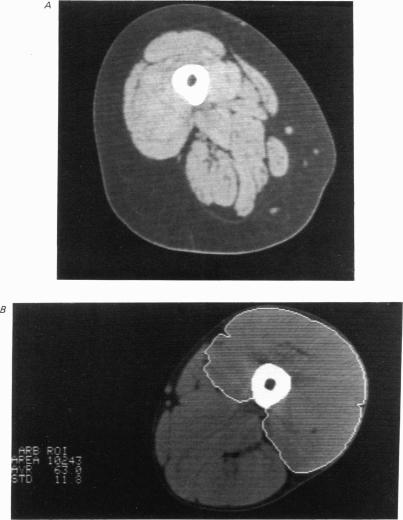
The maximum voluntary force (strength) which could be produced by the knee-extensor muscles, with the knee held at a right angle, was measured in a group of healthy young subjects comprising twenty-five males and twenty-five females. Both legs were tested: data from the stronger leg only for each subject were used in the present study. Computed tomography was used to obtain a cross-sectional image of the subjects' legs at mid-thigh level, measured as the mid-point between the greater trochanter and upper border of the patella. The cross-sectional area of the knee-extensor muscles was determined from the image obtained by computer-based planimetry. The subjects' height and weight were measured. An estimate of body fat content was obtained from measurements of skinfold thicknesses and used to calculate lean body mass. Male subjects were taller (P less than 0.001), heavier (P less than 0.001), leaner (P less than 0.001) and stronger (P less than 0.001) than the female subjects. No significant correlation was found to exist between strength of the knee-extensor muscles and body weight in the male or in the female subjects. In the male subjects, but not in the female group, there was a positive correlation (r = 0.50; P less than 0.01) between strength and lean body mass. Muscle cross-sectional area of the male subjects was greater than that of the female subjects (P less than 0.001). The ratio of strength to cross-sectional area for the male was 9.49 +/- 1.34 (mean +/- S.D.). This is greater but not significantly so, than that for females (8.92 +/- 1.11). In both male and female groups, there was a significant (P less than 0.01) positive correlation between muscle strength and cross-sectional area. A wide variation in the ratio of strength to muscle cross-sectional area was observed. This variability may be a result of anatomical differences between subjects or may result from differences in the proportions of different fibre types in the muscles. The variation between subjects is such that strength is not a useful predictive index of muscle cross-sectional area.
在一组由25名男性和25名女性组成的健康年轻受试者中,测量了膝关节保持直角时膝伸肌所能产生的最大随意力(力量)。对双腿都进行了测试:本研究仅使用了每个受试者较强一侧腿的数据。使用计算机断层扫描获取受试者大腿中部水平腿部的横断面图像,测量点为大转子和髌骨上缘之间的中点。通过基于计算机的平面测量法从获得的图像中确定膝伸肌的横截面积。测量了受试者的身高和体重。通过测量皮褶厚度获得身体脂肪含量的估计值,并用于计算瘦体重。男性受试者比女性受试者更高(P<0.001)、更重(P<0.001)、更瘦(P<0.001)且更强壮(P<0.001)。在男性或女性受试者中,未发现膝伸肌力量与体重之间存在显著相关性。在男性受试者中,而非女性组中,力量与瘦体重之间存在正相关(r = 0.50;P<0.01)。男性受试者的肌肉横截面积大于女性受试者(P<0.001)。男性的力量与横截面积之比为9.49±1.34(平均值±标准差)。这一比值高于女性(8.92±1.11),但差异不显著。在男性和女性组中,肌肉力量与横截面积之间均存在显著的正相关(P<0.01)。观察到力量与肌肉横截面积之比存在很大差异。这种变异性可能是由于受试者之间的解剖学差异,也可能是由于肌肉中不同纤维类型比例的差异所致。受试者之间的差异使得力量并非肌肉横截面积的有效预测指标。