Dent J, Dodds W J, Friedman R H, Sekiguchi T, Hogan W J, Arndorfer R C, Petrie D J
J Clin Invest. 1980 Feb;65(2):256-67. doi: 10.1172/JCI109667.
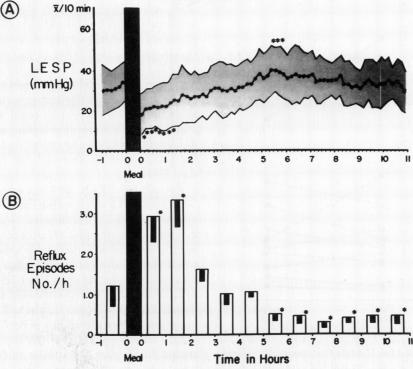
We investigated the mechanism of gastroesophageal reflux (GER) in 10 health volunteer subjects. Continuous recordings of intraluminal esophageal pH and pressure were obtained on two consecutive nights from 6:00 p.m. to 6:30 a.m. in each subject. During each study, the subject remained recumbent, except to eat a standardized meal after 1 h of basal recording. A manometric assembly with seven recording lumens monitored: (a) lower esophageal sphincter (LES) pressure via a sleeve device 6.5 cm in length, (b) esophageal-body motor activity, (c) swallowing activity in the pharynx, and (d) gastric pressure. An electrode 5 cm above the LES recorded esophageal pH. Sleep was monitored by electroencephalogram. All subjects showed wide variations of basal LES pressure. GER was not related to low steady-state basal LES pressure, but rather occurred during transient 5-30 s episodes of inappropriate complete LES relaxation. The inappropriate LES relaxations were usually either spontaneous or immediately followed appropriate sphincter relaxation induced by swallowing. The majority of GER episodes occurred within the first 3 h after eating. During the night LES relaxation and GER occurred only during transient arousals from sleep or when the subjects were fully awake, but not during stable sleep. After GER the esophagus was generally cleared of refluxed acid by primary peristalsis and less frequently by secondary peristalsis. Nonperistaltic contractions were less effective than peristalsis for clearing acid from the esophagus. We conclude that in asymptomatic recumbent subjects GER is related to transient inappropriate LES relaxations rather than to low steady-state basal LES pressure and also, that primary perstalsis is the major mechanism that clears the esophagus of refluxed material.
我们对10名健康志愿者进行了胃食管反流(GER)机制的研究。在每位受试者连续两个晚上的下午6点至凌晨6点30分期间,持续记录食管腔内pH值和压力。在每项研究中,受试者保持卧位,基础记录1小时后除外,此时需进食一顿标准化餐食。一个带有七个记录腔的测压装置监测:(a)通过一个6.5厘米长的套囊装置测量食管下括约肌(LES)压力;(b)食管体部运动活性;(c)咽部吞咽活性;(d)胃内压力。在LES上方5厘米处放置一个电极记录食管pH值。通过脑电图监测睡眠情况。所有受试者的基础LES压力均有很大差异。GER与低稳态基础LES压力无关,而是发生在LES不适当完全松弛的短暂5 - 30秒发作期间。LES的不适当松弛通常是自发的,或者紧接着由吞咽引起的适当括约肌松弛之后发生。大多数GER发作发生在进食后的前3小时内。夜间,LES松弛和GER仅在从睡眠中短暂觉醒或受试者完全清醒时发生,而在稳定睡眠期间不发生。GER发生后,食管内反流的酸通常通过原发性蠕动清除,较少情况下通过继发性蠕动清除。非蠕动性收缩在清除食管内酸方面不如蠕动有效。我们得出结论,在无症状卧位受试者中,GER与LES短暂的不适当松弛有关,而非与低稳态基础LES压力有关,并且原发性蠕动是清除食管内反流物质的主要机制。