D'Halluin J C, Milleville M, Martin G R, Boulanger P
J Virol. 1980 Jan;33(1):88-99. doi: 10.1128/JVI.33.1.88-99.1980.
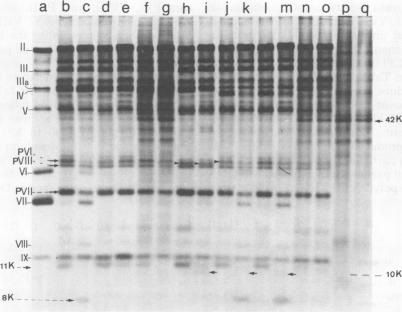
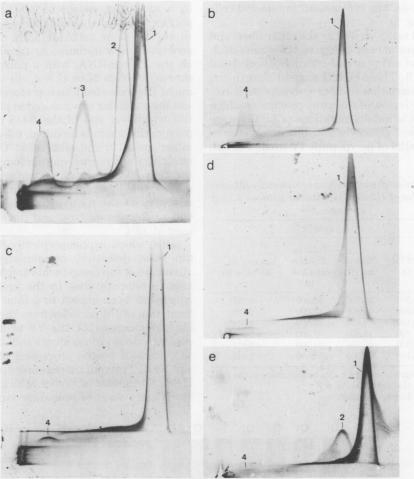
The nature, polypeptide composition, and antigenic composition of the particles formed by six human adenovirus type 2 temperature-sensitive (ts) mutants were studied. ts115, ts116, and ts125 were phenotypically fiber-defective mutants, and ts103, ts104, and ts136 failed to synthesize detectable amounts of fiber plus penton base at 39.5 degrees C. The mutants belonged to five complementation groups, one group including ts116 and ts125. Except for ts103 and ts136, the other mutants were capable of producing particles at 39.5 degrees C. ts116 and ts125 accumulated light assembly intermediate particles (or top components) at nonpermissive temperatures, with few virus particles. The sodium dodecyl sulfate polypeptide pattern of ts116- or ts125-infected cells, intermediate particles, and virus particles showed that polypeptide IV (fiber) was smaller by a molecular weight of 2,000 than that in the wild-type virion and was glycosylated. In fiber plus penton base-defective ts104-infected cells, equivalent quantities of top components and viruses with a buoyant density (rho) of 1.345 g/ml (rho = 1.345 particles) were produced at 39.5 degrees C. These rho = 1.345 particles corresponded to young virions, as evidenced by the presence of uncleaved precursors to proteins VI, VIII, and VII. These young virions matured upon a shift down. Virus capsid vertex antigenic components underwent a phase of eclipse during their incorporation into mature virus particles. No antigenic penton base or IIa was detected in intermediate particles of all the ts mutants tested. Only hexon and traces of fiber antigens were found in ts104 young virions. Penton base and IIIa appeared as fully antigenically expressed capsid subunits in mature wild-type virions or ts104 virions after a shift down. The ts104 lesion is postulated to affect a regulatory function related in some way to penton base and fiber overproduction and the maturation processing of precursors PVI, PVII, and PVII.
对六种人2型腺病毒温度敏感(ts)突变体形成的颗粒的性质、多肽组成和抗原组成进行了研究。ts115、ts116和ts125是表型上纤维缺陷型突变体,ts103、ts104和ts136在39.5℃时无法合成可检测量的纤维加五邻体基座。这些突变体属于五个互补组,其中一组包括ts116和ts125。除ts103和ts136外,其他突变体在39.5℃时能够产生颗粒。ts116和ts125在非允许温度下积累轻装配中间颗粒(或顶部成分),病毒颗粒很少。ts116或ts125感染细胞、中间颗粒和病毒颗粒的十二烷基硫酸钠多肽图谱显示,多肽IV(纤维)的分子量比野生型病毒体中的小2000,并且是糖基化的。在纤维加五邻体基座缺陷的ts104感染细胞中,在39.5℃时产生了等量的顶部成分和浮力密度(ρ)为1.345 g/ml(ρ = 1.345颗粒)的病毒。这些ρ = 1.345颗粒对应于年轻病毒体,蛋白质VI、VIII和VII未切割前体的存在证明了这一点。这些年轻病毒体在温度降低后成熟。病毒衣壳顶点抗原成分在掺入成熟病毒颗粒过程中经历了一个隐蔽期。在所有测试的ts突变体的中间颗粒中未检测到抗原性五邻体基座或IIa。在ts104年轻病毒体中仅发现六邻体和微量的纤维抗原。五邻体基座和IIIa在成熟的野生型病毒体或温度降低后的ts104病毒体中表现为完全抗原表达的衣壳亚基。推测ts104损伤影响某种与五邻体基座和纤维过量产生以及前体PVI、PVII和PVII的成熟加工相关的调节功能。