Chen W, Kuo C
Am J Pathol. 1980 Aug;100(2):365-82.
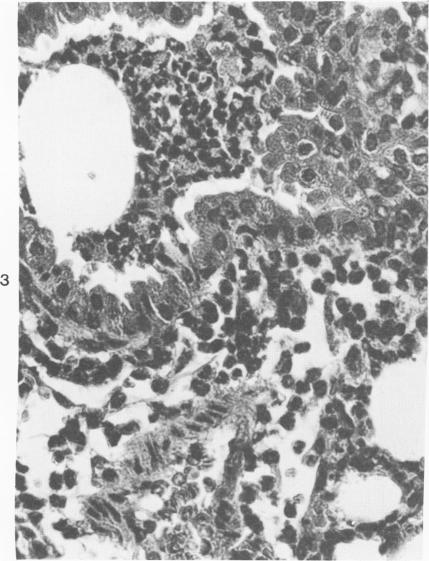
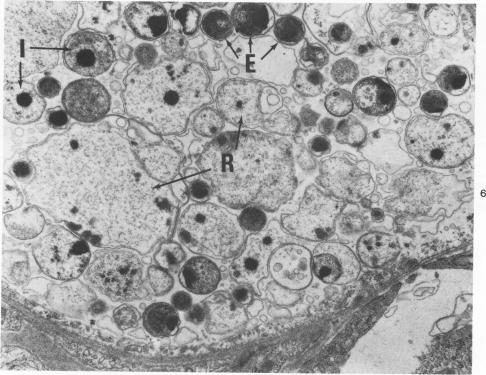
Swiss-Webster white mice were infected with Chlamydia trachomatis organisms through intranasal inoculation. It was found that a typical interstitial pneumonitis could be induced. Histopathologic findings showed that the lung infiltration was predominantly polymorphonuclear cells and was most prominant on Day 2. The cellular infiltrate gradually changed to mononuclear cells after Day 3. Intracytoplasmic inclusions were frequently found in the interstitial cells and occasionally in the bronchial epithelial cells. Typical chlamydial bodies (elementary, intermediate, and reticulate forms) were identified by electron microscopy. The organisms were recovered from mouse lungs on Days 1--7, with the highest yields on Day 2. This correlated with the peak of lung infiltration seen by histologic examination. Antibodies specific to the infecting immunotype began to appear between Day 7 and Day 10 after inoculation and lasted until Day 35 without a decline in titers. A delayed hypersensitivity reaction was observed by footpad test from Day 5 to Day 21, with the peak reaction at Day 7. This study showed that the mouse model could be used to study the immunopathogenesis of C trachomatis infection.
通过鼻内接种,将沙眼衣原体感染瑞士 Webster 品系的小白鼠。发现可诱发典型的间质性肺炎。组织病理学结果显示,肺部浸润主要为多形核细胞,在第 2 天最为明显。第 3 天后,细胞浸润逐渐转变为单核细胞。在间质细胞中经常发现胞质内包涵体,偶尔在支气管上皮细胞中也有发现。通过电子显微镜鉴定出典型的衣原体(原体、中间体和网状体形式)。在第 1 - 7 天从小鼠肺部分离出病原体,第 2 天产量最高。这与组织学检查所见的肺部浸润高峰相关。接种后第 7 天至第 10 天开始出现针对感染免疫型的特异性抗体,持续到第 35 天,滴度没有下降。从第 5 天到第 21 天通过足垫试验观察到迟发型超敏反应,第 7 天反应达到高峰。这项研究表明,该小鼠模型可用于研究沙眼衣原体感染的免疫发病机制。