Monaco L, Foulkes N S, Sassone-Corsi P
Institut de Génétique et de Biologie Moléculaire et Cellulaire, Centre National de la Recherche Scientifique, Institut National de la Santé et de la Recherche Médicale, Université Louis Pasteur, Strasbourg, France.
Proc Natl Acad Sci U S A. 1995 Nov 7;92(23):10673-7. doi: 10.1073/pnas.92.23.10673.
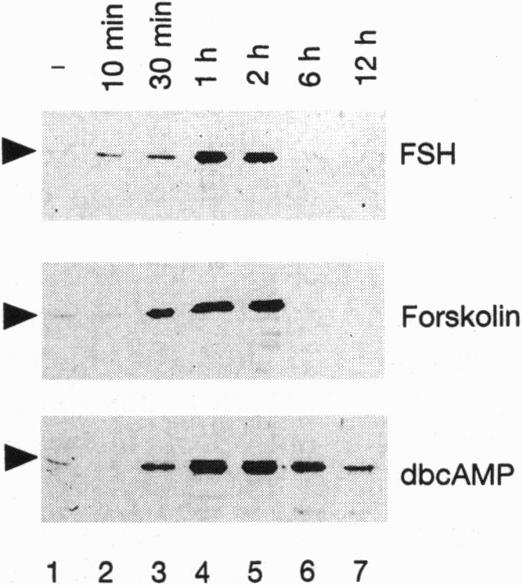
Transcription factor CREM (cAMP-responsive element modulator) plays a pivotal role in the nuclear response to cAMP in neuroendocrine cells. We have previously shown that follicle-stimulating hormone (FSH) directs CREM expression in male germ cells. The physiological importance of FSH in Sertoli cell function prompted us to analyze its effect on CREM expression in these cells. We observed a dramatic and specific increase in the CREM isoform ICER (inducible cAMP early repressor) expression, with a peak 4 h after FSH treatment of primary Sertoli cells. Interestingly, induced levels of ICER protein persist for a considerably longer time. Induction of the repressor ICER accompanies early down-regulation of the FSH receptor transcript, which leads to long-term desensitization. Here we show that ICER represses FSH receptor expression by binding to a CRE-like sequence in the regulatory region of the gene. Our results confirm the crucial role played by CREM in hormonal control and suggest its role in the long-term desensitization phenomenon of peptide membrane receptors.
转录因子CREM(cAMP反应元件调节因子)在神经内分泌细胞对cAMP的核反应中起关键作用。我们之前已经表明,促卵泡激素(FSH)指导雄性生殖细胞中CREM的表达。FSH在支持细胞功能中的生理重要性促使我们分析其对这些细胞中CREM表达的影响。我们观察到CREM异构体ICER(诱导型cAMP早期阻遏物)的表达显著且特异性增加,在FSH处理原代支持细胞后4小时达到峰值。有趣的是,诱导的ICER蛋白水平持续的时间长得多。阻遏物ICER的诱导伴随着FSH受体转录本的早期下调,这导致长期脱敏。在这里我们表明,ICER通过与该基因调控区域中的一个CRE样序列结合来抑制FSH受体的表达。我们的结果证实了CREM在激素控制中所起的关键作用,并表明其在肽膜受体长期脱敏现象中的作用。