Shepherd N A, Baxter K J, Love S B
Department of Histopathology, Gloucestershire Royal Hospital, Gloucester.
J Clin Pathol. 1995 Sep;48(9):849-55. doi: 10.1136/jcp.48.9.849.
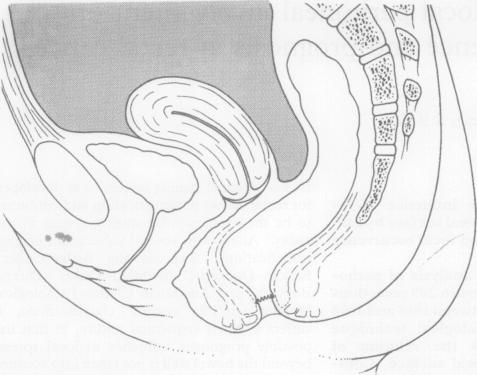
To evaluate the influence of involvement of the peritoneal surface by carcinoma of the rectum on local recurrence and prognosis.
Prospective analysis of pathological prognostic factors in 209 resections for rectal carcinoma between 1988 and 1993 with meticulous pathological technique particularly to assess the relation of tumour to the peritoneal surface. Comprehensive clinical follow up with cause of death established from all available sources of information (hospital and general practitioner data) with necropsies where necessary. Local recurrence was determined by accepted clinical, radiological and pathological criteria.
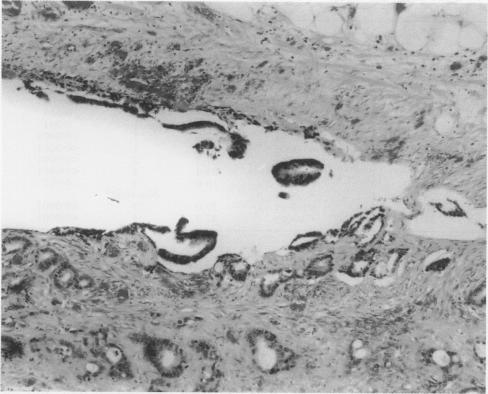
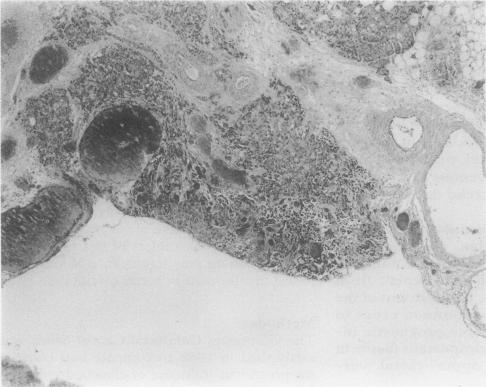
Local peritoneal involvement was detected in 25.8% (54/209) of cases. It was more common in women and was associated with tumour differentiation, size and site, and lymph node involvement. Local peritoneal involvement showed considerable prognostic disadvantage in all cases and in curative cases alone. Multivariate analysis demonstrated independent prognostic disadvantage for all cases although this was lost in the curative group. With a 30 month median follow up time, comprehensive clinical surveillance detected 25 (12.0%) local recurrences. Thirteen (52%) palliative cases had shown spread to involve the mesorectal (deep, circumferential) resection margin. Of the 12 curative cases, six were upper rectal cancers with local peritoneal involvement suggesting that tumour seeding into the pelvic peritoneal cavity was the cause of local recurrence. Local recurrence of the six other rectal tumours was probably because of intraluminal seeding in two, involvement of the distal margin in one, extensive extramural venous involvement in two, and tumour spread to the bladder in one.
Comprehensive pathological analysis of a resection specimen can identify cases with a high probability of local recurrence which may benefit from early adjuvant therapy. Involvement of the peritoneal surface is a common event in rectal cancer, has adverse prognostic influence and may be an important factor in local recurrence of upper rectal carcinoma.
评估直肠癌侵犯腹膜表面对局部复发及预后的影响。
对1988年至1993年间209例直肠癌切除术的病理预后因素进行前瞻性分析,采用细致的病理技术,尤其评估肿瘤与腹膜表面的关系。通过所有可用信息来源(医院和全科医生数据)进行全面临床随访,必要时进行尸检以确定死亡原因。根据公认的临床、放射学和病理学标准确定局部复发情况。
25.8%(54/209)的病例检测到局部腹膜受累。在女性中更常见,且与肿瘤分化、大小、部位及淋巴结受累相关。局部腹膜受累在所有病例及仅在根治性病例中均显示出明显的预后劣势。多因素分析表明,在所有病例中存在独立的预后劣势,尽管在根治性组中这种劣势消失。中位随访时间为30个月,全面临床监测发现25例(12.0%)局部复发。13例(52%)姑息性病例显示已扩散至直肠系膜(深部、环周)切除边缘。在12例根治性病例中,6例为上段直肠癌伴有局部腹膜受累,提示肿瘤播散至盆腔腹膜腔是局部复发的原因。其他6例直肠肿瘤的局部复发可能分别是由于腔内播散2例、远端边缘受累1例、广泛壁外静脉受累2例以及肿瘤扩散至膀胱1例。
对切除标本进行全面病理分析可识别出局部复发可能性高的病例,这些病例可能从早期辅助治疗中获益。腹膜表面受累在直肠癌中是常见情况,具有不良预后影响,可能是上段直肠癌局部复发的重要因素。