Reysenbach A L, Wickham G S, Pace N R
Department of Biology, Indiana University, Bloomington 47405.
Appl Environ Microbiol. 1994 Jun;60(6):2113-9. doi: 10.1128/aem.60.6.2113-2119.1994.
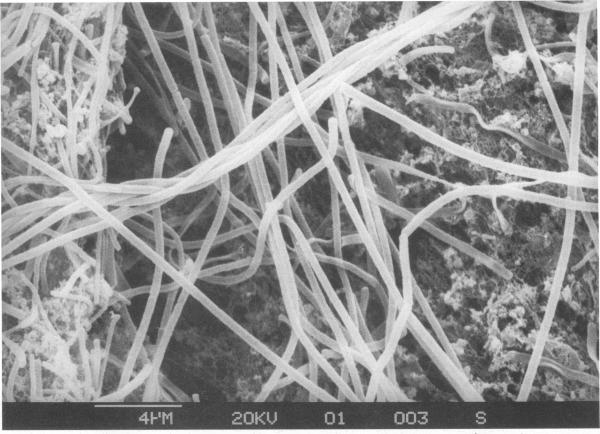
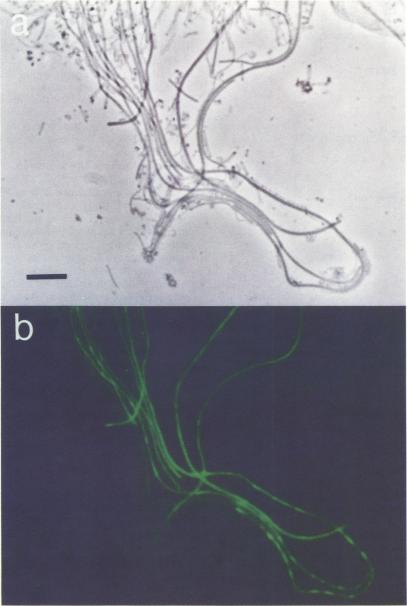
The phylogenetic diversity of a well-known pink filament community associated with the 84 to 88 degrees C outflow from Octopus Spring, Yellowstone National Park, was examined. Three phylogenetic types ("phylotypes"), designated EM 3, EM 17, and EM 19, were identified by cloning and sequencing the small subunit rRNA genes (16S rDNA) obtained by PCR amplification of mixed-population DNA. All three phylotypes diverge deeply within the phylogenetic domain Bacteria sensu Woese (C. R. Woese, O. Kandler, and M. L. Wheelis, Proc. Natl. Acad. Sci. USA 87:4576-4579, 1990). No members of the Archaea or Eucarya were detected. EM 3 comprises a unique lineage within the Thermotogales group, and EM 17 and EM 19 are affiliated with the Aquificales. A total of 35 clones were examined, of which the majority (26 clones) were of a single sequence type (EM 17) closely related to Aquifex pyrophilus. In situ hybridization with clone-specific probes attributes the majority sequence, EM 17, to the pink filaments.
对黄石国家公园章鱼泉84至88摄氏度流出物中一个著名的粉色丝状菌群的系统发育多样性进行了研究。通过对混合群体DNA进行PCR扩增获得的小亚基rRNA基因(16S rDNA)进行克隆和测序,鉴定出三种系统发育类型(“系统型”),分别命名为EM 3、EM 17和EM 19。这三种系统型在Woese意义上的细菌系统发育域(C. R. Woese、O. Kandler和M. L. Wheelis,《美国国家科学院院刊》87:4576 - 4579,1990年)中分歧很大。未检测到古菌或真核生物的成员。EM 3在嗜热栖热菌属组内构成一个独特的谱系,而EM 17和EM 19与产水菌目相关。总共检查了35个克隆,其中大多数(26个克隆)属于与嗜热栖热菌密切相关的单一序列类型(EM 17)。用克隆特异性探针进行原位杂交将大多数序列EM 17归因于粉色丝状体。