Kim J, Kass D H, Deininger P L
Department of Biochemistry and Molecular Biology, Louisiana State University Medical Center, New Orleans 70112, USA.
Nucleic Acids Res. 1995 Jun 25;23(12):2245-51. doi: 10.1093/nar/23.12.2245.
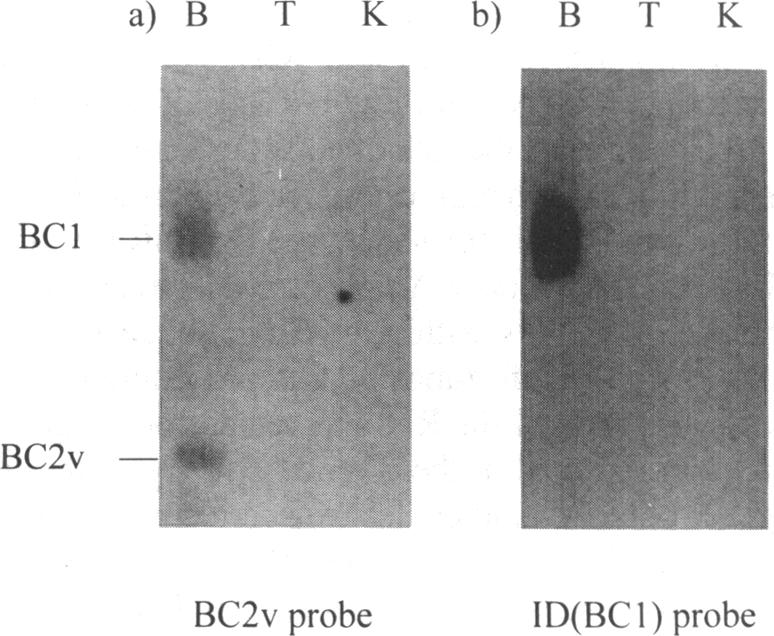
ID elements comprise a rodent SINE (short interspersed DNA repetitive element) family that has amplified by retroposition of a few master genes. In order to understand the important factors of SINE amplification, we investigated the transcription of rat ID elements. Three different size classes of ID transcripts, BC1, BC2 and T3, have been detected in various rat tissues, including brain and testes. We have analysed the nucleotide sequences of testes- and brain-derived ID transcripts isolated by size-fractionation, C-tailing and RACE. Nucleotide sequence variation of testes ID transcripts demonstrated derivation from different loci. However, the transcripts represent a preferred set of ID elements that closely match the subfamily consensus sequences. The small ID transcripts, T3, are not comprised of primary transcripts, but are instead processed polyA-transcripts generated from many different loci. These truncated transcripts would be expected to be retroposition-incompetent forms. Therefore, the amplification of ID elements is likely to be regulated at multiple steps of retroposition, which include transcription and processing. Although brain ID transcripts showed a similar pattern, with the addition of very high levels of transcription from the BC1 locus, we also found evidence that a single locus dominated the production of brain BC2 RNA species. BC1 RNA is highly stable in both germ line and brain cells, based on the low level of detection of the processing product, T3. This stability of BC1 RNA might have been a contributing factor in its role as a master gene for ID amplification.
ID元件包含一个啮齿动物短散在DNA重复元件(SINE)家族,该家族通过少数主基因的逆转座而扩增。为了了解SINE扩增的重要因素,我们研究了大鼠ID元件的转录情况。在包括脑和睾丸在内的各种大鼠组织中检测到了三种不同大小类别的ID转录本,即BC1、BC2和T3。我们分析了通过大小分级、加尾和RACE分离的睾丸和脑源ID转录本的核苷酸序列。睾丸ID转录本的核苷酸序列变异表明其来源于不同的基因座。然而,这些转录本代表了一组与亚家族共有序列紧密匹配的优选ID元件。小的ID转录本T3不是由初级转录本组成,而是由许多不同基因座产生的加工后的多聚腺苷酸转录本。这些截短的转录本预计是无逆转座能力的形式。因此,ID元件的扩增可能在逆转座的多个步骤中受到调控,包括转录和加工。虽然脑ID转录本显示出类似的模式,即BC1基因座有非常高水平的转录,但我们也发现有证据表明单个基因座主导了脑BC2 RNA种类的产生。基于加工产物T3的低检测水平,BC1 RNA在生殖细胞和脑细胞中都高度稳定。BC1 RNA的这种稳定性可能是其作为ID扩增主基因发挥作用的一个促成因素。