Maraia R J, Driscoll C T, Bilyeu T, Hsu K, Darlington G J
Laboratory of Molecular Growth Regulation, National Institute of Child Health and Human Development, Bethesda, Maryland 20892.
Mol Cell Biol. 1993 Jul;13(7):4233-41. doi: 10.1128/mcb.13.7.4233-4241.1993.
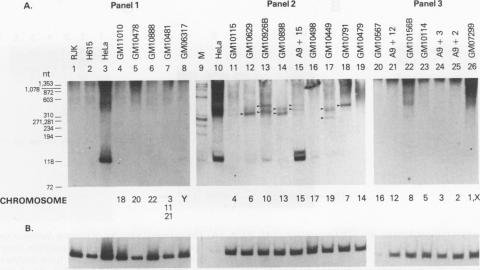
Alu repeats are short interspersed elements (SINEs) of dimeric structure whose transposition sometimes leads to heritable disorders in humans. Human cells contain a poly(A)- small cytoplasmic transcript of -120 nucleotides (nt) homologous to the left Alu monomer. Although its monomeric size indicates that small cytoplasmic Alu (scAlu) RNA is not an intermediary of human Alu transpositions, a less abundant poly(A)-containing Alu transcript of dimeric size and specificity expected of a transposition intermediary is also detectable in HeLa cells (A. G. Matera, U. Hellmann, M. F. Hintz, and C. W. Schmid, Mol. Cell. Biol. 10:5424-5432, 1990). Although its function is unknown, the accumulation of Alu RNA and its ability to interact with a conserved protein suggest a role in cell biology (D.-Y. Chang and R. J. Maraia, J. Biol. Chem. 268:6423-28, 1993). The relationship between the -120- and -300-nt Alu transcripts had not been determined. However, a B1 SINE produces scB1 RNA by posttranscriptional processing, suggesting a similar pathway for scAlu. An Alu SINE which recently transposed into the neurofibromatosis 1 locus was expressed in microinjected frog oocytes. This neurofibromatosis 1 Alu produced a primary transcript followed by the appearance of the scAlu species. 3' processing of a synthetic -300-nt Alu RNA by HeLa nuclear extract in vitro also produced scAlu RNA. Primer extension of scAlu RNA indicates synthesis by RNA polymerase III. HeLa-derived scAlu cDNAs were cloned so as to preserve their 5'-terminal sequences and were found to correspond to polymerase III transcripts of the left monomeric components of three previously identified Alu SINE subfamilies. Rodent x human somatic cell hybrids express Alu RNAs whose size, heterogeneous length, and chromosomal distribution indicate their derivation from SINEs. The coexpression of dimeric and monomeric Alu RNA in several hybrids suggests a precursor-product relationship.
Alu重复序列是具有二聚体结构的短散在元件(SINEs),其转座有时会导致人类遗传性疾病。人类细胞含有一种与左Alu单体同源的-120个核苷酸(nt)的聚腺苷酸小细胞质转录本。尽管其单体大小表明小细胞质Alu(scAlu)RNA不是人类Alu转座的中间体,但在HeLa细胞中也可检测到一种丰度较低、具有转座中间体预期的二聚体大小和特异性的含聚腺苷酸的Alu转录本(A.G. Matera、U. Hellmann、M.F. Hintz和C.W. Schmid,《分子细胞生物学》10:5424 - 5432,1990年)。尽管其功能尚不清楚,但Alu RNA的积累及其与一种保守蛋白相互作用的能力表明其在细胞生物学中发挥作用(D.-Y. Chang和R.J. Maraia,《生物化学杂志》268:6423 - 6428,1993年)。-120 nt和-300 nt的Alu转录本之间的关系尚未确定。然而,一个B1 SINE通过转录后加工产生scB1 RNA,这表明scAlu可能有类似的途径。一个最近转座到神经纤维瘤病1基因座的Alu SINE在显微注射的蛙卵母细胞中表达。这个神经纤维瘤病1 Alu产生一个初级转录本,随后出现scAlu物种。HeLa细胞核提取物在体外对合成的-300 nt Alu RNA进行了3'加工,也产生了scAlu RNA。scAlu RNA的引物延伸表明其由RNA聚合酶III合成。克隆了源自HeLa的scAlu cDNA,以保留其5'末端序列,发现它们对应于三个先前鉴定的Alu SINE亚家族左单体成分的聚合酶III转录本。啮齿动物×人类体细胞杂种表达的Alu RNA,其大小、长度异质性和染色体分布表明它们源自SINEs。几种杂种中二聚体和单体Alu RNA的共表达表明存在前体-产物关系。