• 文献检索
  • 文档翻译
  • 深度研究
  • 学术资讯
  • Suppr Zotero 插件Zotero 插件
  • 邀请有礼
  • 套餐&价格
  • 历史记录
应用&插件
Suppr Zotero 插件Zotero 插件浏览器插件Mac 客户端Windows 客户端微信小程序
定价
高级版会员购买积分包购买API积分包
服务
文献检索文档翻译深度研究API 文档MCP 服务
关于我们
关于 Suppr公司介绍联系我们用户协议隐私条款
关注我们

Suppr 超能文献

核心技术专利:CN118964589B侵权必究
粤ICP备2023148730 号-1Suppr @ 2026

文献检索

告别复杂PubMed语法,用中文像聊天一样搜索,搜遍4000万医学文献。AI智能推荐,让科研检索更轻松。

立即免费搜索

文件翻译

保留排版,准确专业,支持PDF/Word/PPT等文件格式,支持 12+语言互译。

免费翻译文档

深度研究

AI帮你快速写综述,25分钟生成高质量综述,智能提取关键信息,辅助科研写作。

立即免费体验

一种在前列腺癌进展过程中检测分子标志物的显微切割方法。

A microdissection approach to detect molecular markers during progression of prostate cancer.

作者信息

Berthon P, Dimitrov T, Stower M, Cussenot O, Maitland N J

机构信息

Department of Biology, University of York, Heslington, UK.

出版信息

Br J Cancer. 1995 Oct;72(4):946-51. doi: 10.1038/bjc.1995.439.

DOI:10.1038/bjc.1995.439
PMID:7547246
原文链接:https://pmc.ncbi.nlm.nih.gov/articles/PMC2034022/
Abstract

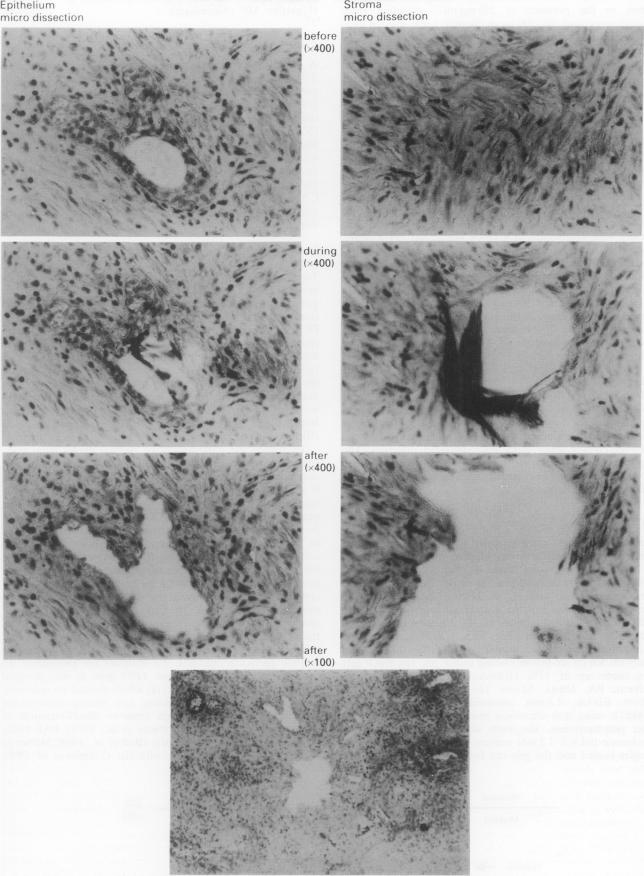
To investigate the underlying mechanisms of carcinogenesis, we have developed a technique to determine the frequency of genetic changes in prostatic carcinoma tissue. We have demonstrated that at a ratio of between 1:4 and 1:9 mutant-normal alleles, the signal from a mutant TP53 allele is not apparent after polymerase chain reaction (PCR) amplification and further direct sequencing or single-strand conformation polymorphism (SSCP) analysis. To bypass this problem, which is inherent in the heterogeneity of the prostate tissue and of the tumour, we selected areas of graded prostate tumours (Gleason score) from cryosectioned preparations and microdissected these cells (20-100 cells). After anionic resin removal of proteins, PCR amplification of TP53 gene exons 5/6 and SSCP analysis, an abnormal SSCP band shift was observed in suspected tumour cells, compared with microdissected stromal cells used as an internal control, while (1) a crude preparation of tissue DNA carrying the tumour did not show any abnormality and (2) immunostaining by a set of monoclonal antibodies against TP53 protein remained negative. Nucleotide sequence analysis of the different bands confirmed the presence of a mutation in the TP53 gene exon 6 position 13,336 in an abnormal band for one specimen, while no mutation was detected in the normal SSCP band. By targeting recognised tumour cells we can find DNA mutations which are undetectable using the standard technique of whole-tissue DNA extraction, particularly in a heterogeneous tumour such as carcinoma of the prostate.

摘要

为了研究致癌作用的潜在机制,我们开发了一种技术来确定前列腺癌组织中基因变化的频率。我们已经证明,当突变型与正常等位基因的比例在1:4至1:9之间时,聚合酶链反应(PCR)扩增以及进一步的直接测序或单链构象多态性(SSCP)分析后,来自突变型TP53等位基因的信号并不明显。为了绕过这个前列腺组织和肿瘤异质性所固有的问题,我们从冷冻切片标本中选择了不同分级的前列腺肿瘤区域(Gleason评分),并对这些细胞进行显微切割(20 - 100个细胞)。在用阴离子树脂去除蛋白质后,对TP53基因第5/6外显子进行PCR扩增和SSCP分析,与用作内部对照的显微切割基质细胞相比,在疑似肿瘤细胞中观察到异常的SSCP条带迁移,而(1)携带肿瘤的组织DNA粗提物未显示任何异常,并且(2)用一组抗TP53蛋白的单克隆抗体进行免疫染色仍为阴性。对不同条带的核苷酸序列分析证实,一个标本的异常条带中TP53基因第6外显子13336位存在突变,而在正常SSCP条带中未检测到突变。通过靶向识别肿瘤细胞,我们能够发现使用全组织DNA提取的标准技术无法检测到的DNA突变,特别是在前列腺癌这种异质性肿瘤中。

https://cdn.ncbi.nlm.nih.gov/pmc/blobs/04ce/2034022/4eb5238dc980/brjcancer00044-0150-a.jpg
https://cdn.ncbi.nlm.nih.gov/pmc/blobs/04ce/2034022/88833becbbc5/brjcancer00044-0147-a.jpg
https://cdn.ncbi.nlm.nih.gov/pmc/blobs/04ce/2034022/e3a3fbdde0cd/brjcancer00044-0148-a.jpg
https://cdn.ncbi.nlm.nih.gov/pmc/blobs/04ce/2034022/b0b9584667a5/brjcancer00044-0149-a.jpg
https://cdn.ncbi.nlm.nih.gov/pmc/blobs/04ce/2034022/4eb5238dc980/brjcancer00044-0150-a.jpg
https://cdn.ncbi.nlm.nih.gov/pmc/blobs/04ce/2034022/88833becbbc5/brjcancer00044-0147-a.jpg
https://cdn.ncbi.nlm.nih.gov/pmc/blobs/04ce/2034022/e3a3fbdde0cd/brjcancer00044-0148-a.jpg
https://cdn.ncbi.nlm.nih.gov/pmc/blobs/04ce/2034022/b0b9584667a5/brjcancer00044-0149-a.jpg
https://cdn.ncbi.nlm.nih.gov/pmc/blobs/04ce/2034022/4eb5238dc980/brjcancer00044-0150-a.jpg

相似文献

1
A microdissection approach to detect molecular markers during progression of prostate cancer.一种在前列腺癌进展过程中检测分子标志物的显微切割方法。
Br J Cancer. 1995 Oct;72(4):946-51. doi: 10.1038/bjc.1995.439.
2
p53 abnormalities in primary prostate cancer: single-strand conformation polymorphism analysis of complementary DNA in comparison with genomic DNA. The Cooperative Prostate Network.原发性前列腺癌中的p53异常:与基因组DNA相比,互补DNA的单链构象多态性分析。前列腺癌协作网络。
J Natl Cancer Inst. 1997 Jan 1;89(1):66-71. doi: 10.1093/jnci/89.1.66.
3
p53 Immunostaining guided laser capture microdissection (p53-LCM) defines the presence of p53 gene mutations in focal regions of primary prostate cancer positive for p53 protein.p53免疫染色引导的激光捕获显微切割(p53-LCM)可确定原发性前列腺癌中p53蛋白呈阳性的局灶区域是否存在p53基因突变。
Prostate Cancer Prostatic Dis. 2003;6(4):281-5. doi: 10.1038/sj.pcan.4500665.
4
p53 protein accumulation and gene mutation in the progression of human prostate carcinoma.p53蛋白积累与基因突变在人类前列腺癌进展中的作用
J Natl Cancer Inst. 1993 Oct 20;85(20):1657-69. doi: 10.1093/jnci/85.20.1657.
5
Frequency and characterization of p53 mutations in clinically localized prostate cancer.临床局限性前列腺癌中p53突变的频率及特征
Urology. 1995 Mar;45(3):470-5. doi: 10.1016/s0090-4295(99)80018-1.
6
Identification of p53 mutations in archival prostate tumors. Sensitivity of an optimized single-strand conformational polymorphism (SSCP) assay.存档前列腺肿瘤中p53突变的鉴定。优化的单链构象多态性(SSCP)检测方法的灵敏度。
Diagn Mol Pathol. 1996 Dec;5(4):271-8. doi: 10.1097/00019606-199612000-00008.
7
P53 tumour-suppressor gene mutations are mainly localised on exon 7 in human primary and metastatic prostate cancer.P53肿瘤抑制基因突变主要定位于人类原发性和转移性前列腺癌的第7外显子。
Br J Cancer. 1996 Jul;74(2):264-8. doi: 10.1038/bjc.1996.349.
8
p53 gene alterations in prostate cancer after radiation failure and their association with clinical outcome: a molecular and immunohistochemical analysis.
Pathol Res Pract. 1999;195(3):129-35. doi: 10.1016/S0344-0338(99)80024-7.
9
Mutation of the p53 gene precedes aneuploid clonal divergence in colorectal carcinoma.p53基因的突变先于结直肠癌中的非整倍体克隆分化。
Br J Cancer. 1995 Feb;71(2):215-8. doi: 10.1038/bjc.1995.46.
10
Molecular pathology of primary and metastatic ductal pancreatic lesions: analyses of mutations and expression of the p53, mdm-2, and p21/WAF-1 genes in sporadic and familial lesions.原发性和转移性胰腺导管病变的分子病理学:散发性和家族性病变中p53、mdm-2和p21/WAF-1基因的突变及表达分析
Cancer. 1997 Feb 15;79(4):700-16.

引用本文的文献

1
Epigenetic DNA methylation of antioxidative stress regulator NRF2 in human prostate cancer.人类前列腺癌中抗氧化应激调节因子NRF2的表观遗传DNA甲基化
Cancer Prev Res (Phila). 2014 Dec;7(12):1186-97. doi: 10.1158/1940-6207.CAPR-14-0127. Epub 2014 Sep 29.
2
Cancer biomarker discovery: the entropic hallmark.癌症生物标志物的发现:熵的标志。
PLoS One. 2010 Aug 18;5(8):e12262. doi: 10.1371/journal.pone.0012262.
3
Phenotype-specific CpG island methylation events in a murine model of prostate cancer.前列腺癌小鼠模型中表型特异性的CpG岛甲基化事件。

本文引用的文献

1
p53 gene alterations in human prostate carcinoma.
J Urol. 1993 Jul;150(1):257-61. doi: 10.1016/s0022-5347(17)35458-7.
2
Rodent models for targeted oncogenesis of the prostate gland.前列腺靶向肿瘤发生的啮齿动物模型。
Cancer Metastasis Rev. 1993 Mar;12(1):11-9. doi: 10.1007/BF00689786.
3
Cloning the differences between two complex genomes.克隆两个复杂基因组之间的差异。
Science. 1993 Feb 12;259(5097):946-51. doi: 10.1126/science.8438152.
Cancer Res. 2008 Jun 1;68(11):4173-82. doi: 10.1158/0008-5472.CAN-07-6715.
4
Mutant p53 expression in prostate carcinoma.突变型p53在前列腺癌中的表达
Prostate. 1993;22(1):23-30. doi: 10.1002/pros.2990220104.
5
Detection of human papillomavirus (HPV) DNA in human prostatic tissues by polymerase chain reaction (PCR).通过聚合酶链反应(PCR)检测人前列腺组织中的人乳头瘤病毒(HPV)DNA。
Prostate. 1993;22(2):171-80. doi: 10.1002/pros.2990220210.
6
p53 is mutated in a subset of advanced-stage prostate cancers.在一部分晚期前列腺癌中,p53发生了突变。
Cancer Res. 1993 Jul 15;53(14):3369-73.
7
Frequency and characterization of p53 mutations in primary and metastatic human prostate cancer.原发性和转移性人类前列腺癌中p53突变的频率及特征
Int J Cancer. 1994 Mar 1;56(5):630-3. doi: 10.1002/ijc.2910560504.
8
Mutations in the p53 tumor suppressor gene: clues to cancer etiology and molecular pathogenesis.p53肿瘤抑制基因的突变:癌症病因学和分子发病机制的线索
Cancer Res. 1994 Sep 15;54(18):4855-78.
9
Database of p53 gene somatic mutations in human tumors and cell lines.人类肿瘤和细胞系中p53基因体细胞突变数据库。
Nucleic Acids Res. 1994 Sep;22(17):3551-5.
10
Database and software for the analysis of mutations at the human p53 gene.用于分析人类p53基因突变的数据库和软件。
Nucleic Acids Res. 1994 Sep;22(17):3549-50.