Bambrick L L, Yarowsky P J, Krueger B K
Department of Physiology, University of Maryland School of Medicine, Baltimore 21201, USA.
Proc Natl Acad Sci U S A. 1995 Oct 10;92(21):9692-6. doi: 10.1073/pnas.92.21.9692.
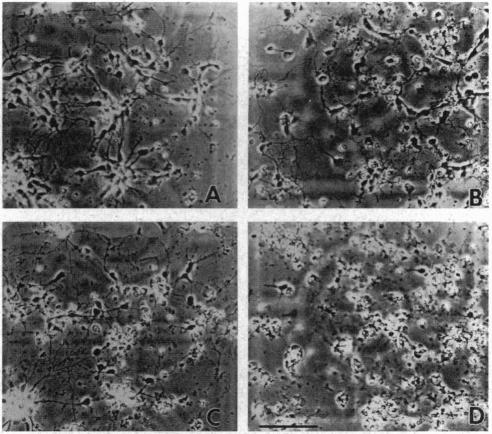
The survival of cultured mouse hippocampal neurons was found to be greatly enhanced by micromolar concentrations of the excitatory neurotransmitter glutamate. Blockade of kainate/AMPA (alpha-amino-3-hydroxy-5-methyl-4-isoxazole propionic acid) glutamate receptors increased the rate of neuron death, suggesting that endogenous glutamate in the cultures promotes survival. Addition of glutamate (0.5-1 microM) further increased neuron survival, whereas glutamate in excess of 20 microM resulted in increased death. Thus, the survival vs. glutamate dose-response relation is bell-shaped with an optimal glutamate concentration near 1 microM. We found that hippocampal neurons from mice with the genetic defect trisomy 16 (Ts16) died 2-3 times faster than normal (euploid) neurons. Moreover, glutamate, at all concentrations tested, failed to increase survival of Ts16 neurons. In contrast, the neurotrophic polypeptide basic fibroblast growth factor did increase the survival of Ts16 and euploid neurons. Ts16 is a naturally occurring mouse genetic abnormality, the human analog of which (Down syndrome) leads to altered brain development and Alzheimer disease. These results demonstrate that the Ts16 genotype confers a defect in the glutamate-mediated survival response of hippocampal neurons and that this defect can contribute to their accelerated death.
研究发现,微摩尔浓度的兴奋性神经递质谷氨酸可显著提高培养的小鼠海马神经元的存活率。阻断海人藻酸/α-氨基-3-羟基-5-甲基-4-异恶唑丙酸(AMPA)型谷氨酸受体可加快神经元死亡速度,这表明培养物中的内源性谷氨酸可促进神经元存活。添加谷氨酸(0.5 - 1微摩尔)可进一步提高神经元存活率,而超过20微摩尔的谷氨酸则会导致死亡率增加。因此,存活率与谷氨酸剂量反应关系呈钟形,最佳谷氨酸浓度接近1微摩尔。我们发现,患有16三体综合征(Ts16)这一基因缺陷的小鼠的海马神经元死亡速度比正常(整倍体)神经元快2至3倍。此外,在所有测试浓度下,谷氨酸均无法提高Ts16神经元的存活率。相比之下,神经营养多肽碱性成纤维细胞生长因子确实可提高Ts16和整倍体神经元的存活率。Ts16是一种自然发生的小鼠基因异常,其人类对应物(唐氏综合征)会导致大脑发育改变和阿尔茨海默病。这些结果表明,Ts16基因型导致海马神经元谷氨酸介导的存活反应存在缺陷,且这种缺陷可能导致它们加速死亡。