Sauer F, Jäckle H
Abteilung Molekulare Entwicklungsbiologie, Max-Planck-Institut für biophysikalische Chemie, Göttingen, Germany.
EMBO J. 1995 Oct 2;14(19):4773-80. doi: 10.1002/j.1460-2075.1995.tb00159.x.
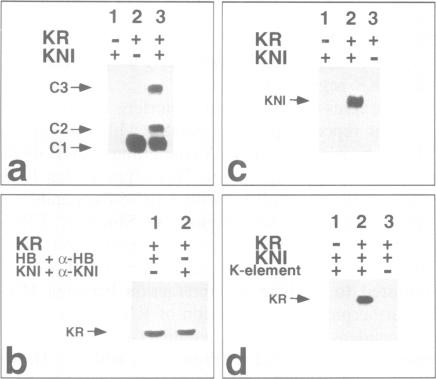
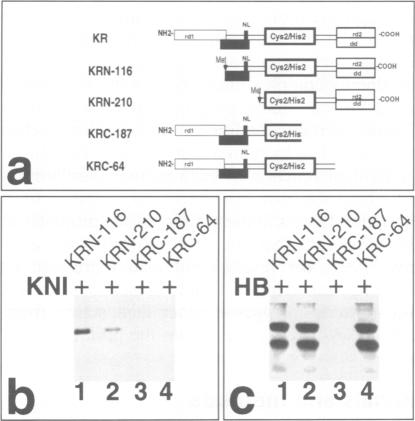
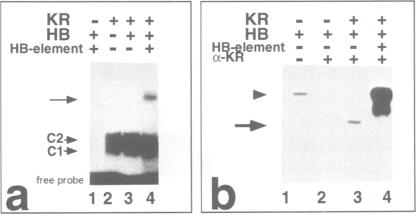
The Drosophila gap gene Krüppel (Kr) encodes a transcriptional regulator. It acts both as an integral part of the Drosophila segmentation gene in the early blastoderm and in a variety of tissues and organs at later stages of embryogenesis. In transfected tissue culture cells, the Kr protein (Kr) was shown to both activate and repress gene expression in a concentration-dependent manner when acting from a single binding site close to the promoter. Here we show that KR can associate with the transcription factors encoded by the gap genes knirps (kni) and hunchback (hb) which affect KR-dependent gene expression in Drosophila tissue culture cells. The association of DNA-bound hb protein or free kni protein with distinct but different regions of KR results in the formation of DNA-bound transcriptional repressor complexes. Our results suggest that individual transcription factors can associate to form protein complexes which act as direct repressors of transcription. The interactions shown here add an unexpected level of complexity to the control of gene expression.
果蝇缺口基因Krüppel(Kr)编码一种转录调节因子。它在早期胚盘阶段作为果蝇体节基因的一个组成部分发挥作用,并且在胚胎发育后期的各种组织和器官中也有作用。在转染的组织培养细胞中,当从靠近启动子的单个结合位点起作用时,Kr蛋白(KR)被证明以浓度依赖的方式激活和抑制基因表达。在这里我们表明,KR可以与缺口基因驼背(hb)和大腹便便(kni)编码的转录因子结合,这两种因子会影响果蝇组织培养细胞中依赖KR的基因表达。与DNA结合的hb蛋白或游离的kni蛋白与KR的不同区域结合,会导致形成与DNA结合的转录抑制复合物。我们的结果表明,单个转录因子可以结合形成蛋白质复合物,作为转录的直接抑制因子。这里所示的相互作用为基因表达的控制增添了意想不到的复杂程度。