Sakurai H, Kohsaka H, Liu M F, Higashiyama H, Hirata Y, Kanno K, Saito I, Miyasaka N
Division of Immunological Diseases, Medical Research Institute, Tokyo, Japan.
J Clin Invest. 1995 Nov;96(5):2357-63. doi: 10.1172/JCI118292.
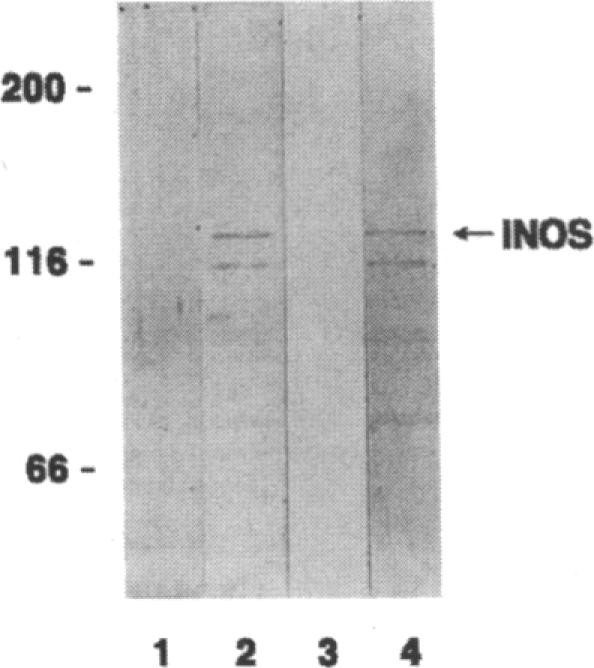
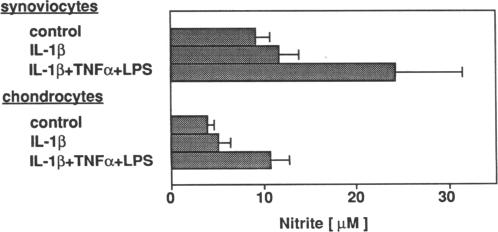
In this study, we have identified the source of nitric oxide (NO) produced in the human inflammatory joints by analyzing expression of inducible NO synthase. In ex vivo organ cultures, both inflammatory synovium and cartilage from patients with rheumatoid arthritis produced NO. The NO production was suppressed by NG-monomethyl-L-arginine, an inhibitor of NO synthase. The amount of NO produced by the synovium correlated with the proportion of CD14+ cells in the corresponding tissue (r = 0.8, P < 0.05). Immunohistochemical analysis as well as in situ hybridization showed that inducible NO synthase was predominantly expressed in synovial lining cells, endothelial cells, chondrocytes, and to a lesser extent, in infiltrating mononuclear cells and synovial fibroblasts. The synovial lining cells and the infiltrating cells expressing inducible NO synthase were identified where CD14+ cells were located. Together with morphological features, this suggests that they are type A synoviocytes. NO production from freshly isolated synoviocytes and chondrocytes was up-regulated by in vitro stimulation with a combination of IL-TNF-beta, TNF-alpha, and LPS. In summary, the present results suggest that NO is produced primarily by CD14+ synoviocytes, chondrocytes, and endothelial cells in inflammatory joints of arthritides. NO production can be upregulated by cytokines present in inflamed joints. The increased NO production may thus contribute to the pathological features in inflammatory arthritides.
在本研究中,我们通过分析诱导型一氧化氮合酶的表达,确定了人类炎症关节中产生一氧化氮(NO)的来源。在体外器官培养中,类风湿性关节炎患者的炎症滑膜和软骨均产生NO。NO的产生受到NO合酶抑制剂NG-单甲基-L-精氨酸的抑制。滑膜产生的NO量与相应组织中CD14+细胞的比例相关(r = 0.8,P < 0.05)。免疫组织化学分析以及原位杂交显示,诱导型NO合酶主要表达于滑膜衬里细胞、内皮细胞、软骨细胞,在浸润的单核细胞和滑膜成纤维细胞中表达较少。在CD14+细胞所在位置发现了表达诱导型NO合酶的滑膜衬里细胞和浸润细胞。结合形态学特征,这表明它们是A型滑膜细胞。新鲜分离的滑膜细胞和软骨细胞经IL-TNF-β、TNF-α和LPS联合体外刺激后,NO产生上调。总之,目前的结果表明,NO主要由关节炎炎症关节中的CD14+滑膜细胞、软骨细胞和内皮细胞产生。炎症关节中存在的细胞因子可上调NO的产生。因此,NO产生的增加可能导致炎症性关节炎的病理特征。