
人白细胞介素-1受体拮抗剂的抑制活性可被Ⅱ型白细胞介素-1可溶性受体增强,而被Ⅰ型白细胞介素-1可溶性受体抑制。
The inhibitory activity of human interleukin-1 receptor antagonist is enhanced by type II interleukin-1 soluble receptor and hindered by type I interleukin-1 soluble receptor.
作者信息
Burger D, Chicheportiche R, Giri J G, Dayer J M
机构信息
Hans Wilsdorf Laboratory, Department of Medicine, University Hospital, Geneva, Switzerland.
出版信息
J Clin Invest. 1995 Jul;96(1):38-41. doi: 10.1172/JCI118045.
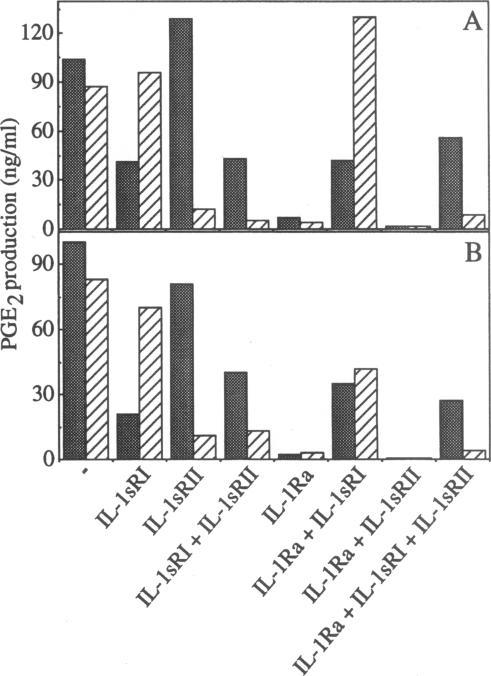
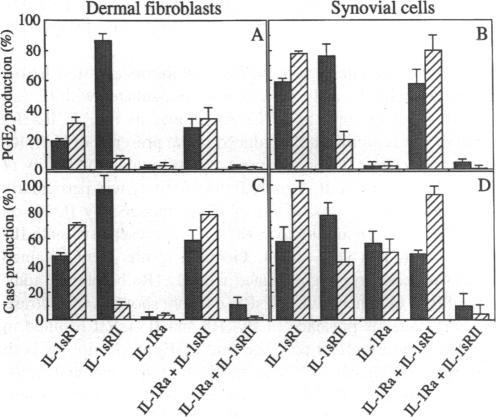
Interleukin-1 (IL-1) is a major proinflammatory cytokine produced by monocytes/macrophages. At the inflammatory site, IL-1 is a potent inducer of the production of prostaglandin E2 (PGE2) and metalloproteinases on fibroblast-like cells, thus triggering tissue damage. The biological activity of IL-1 is counterbalanced by two types of inhibitors: the IL-1 receptor antagonist (IL-1Ra) which competitively binds IL-1 receptor without inducing signal transduction; and IL-1 soluble receptors (IL-1sR) which bind IL-1 and diminish the free concentration of soluble cytokine, thus hampering its binding to the cell surface receptor. Since IL-1sR can also bind IL-1Ra, we studied the simultaneous effects of both inhibitors on the production of interstitial collagenase (C'ase) and PGE2 by human dermal fibroblasts and synovial cells stimulated by either IL-1 alpha or IL-1 beta. IL-1Ra inhibited fibroblast and synovial cell stimulation by approximately 90%, with the exception of C'ase production by synovial cells which was inhibited by approximately 55%. Type I IL-1sR (IL-1sRI) preferentially inhibited IL-1 alpha, whereas type II IL-1sR (IL-1sRII) mainly inhibited IL-1 beta. When IL-1Ra was used simultaneously with IL-1sRI, the final inhibition was lower than that of either of the inhibitors. The simultaneous presence of IL-1Ra and IL-1sRII abolished the IL-1-induced production of PGE2 and C'ase on both dermal fibroblasts and synovial cells, demonstrating that concurrently these two inhibitors are able to abolish most of the inflammatory response. To our knowledge, this is the first example of two types of inhibitors that abolish each other's effects, one of which acts at the receptor level and the other at the ligand level, thus leaving ligand activity unimpaired.
白细胞介素-1(IL-1)是由单核细胞/巨噬细胞产生的一种主要促炎细胞因子。在炎症部位,IL-1是成纤维样细胞上前列腺素E2(PGE2)和金属蛋白酶产生的强效诱导剂,从而引发组织损伤。IL-1的生物活性受到两种抑制剂的平衡:IL-1受体拮抗剂(IL-1Ra),其竞争性结合IL-1受体而不诱导信号转导;以及IL-1可溶性受体(IL-1sR),其结合IL-1并降低可溶性细胞因子的游离浓度,从而阻碍其与细胞表面受体的结合。由于IL-1sR也能结合IL-1Ra,我们研究了这两种抑制剂对人皮肤成纤维细胞和滑膜细胞在受到IL-1α或IL-1β刺激时产生间质胶原酶(C'ase)和PGE2的同时作用。IL-1Ra抑制成纤维细胞和滑膜细胞的刺激约90%,滑膜细胞产生C'ase的情况除外,其受到的抑制约为55%。I型IL-1sR(IL-1sRI)优先抑制IL-1α,而II型IL-1sR(IL-1sRII)主要抑制IL-1β。当IL-1Ra与IL-1sRI同时使用时,最终抑制作用低于任何一种抑制剂。IL-1Ra和IL-1sRII同时存在时,可消除IL-1诱导的皮肤成纤维细胞和滑膜细胞中PGE2和C'ase的产生,表明这两种抑制剂同时作用能够消除大部分炎症反应。据我们所知,这是两种抑制剂相互抵消作用的首个例子,其中一种在受体水平起作用,另一种在配体水平起作用,从而使配体活性不受影响。
 Zotero 插件