Hall J, Black G W, Ferreira L M, Millward-Sadler S J, Ali B R, Hazlewood G P, Gilbert H J
Department of Biological and Nutritional Sciences, University of Newcastle upon Tyne, UK.
Biochem J. 1995 Aug 1;309 ( Pt 3)(Pt 3):749-56. doi: 10.1042/bj3090749.
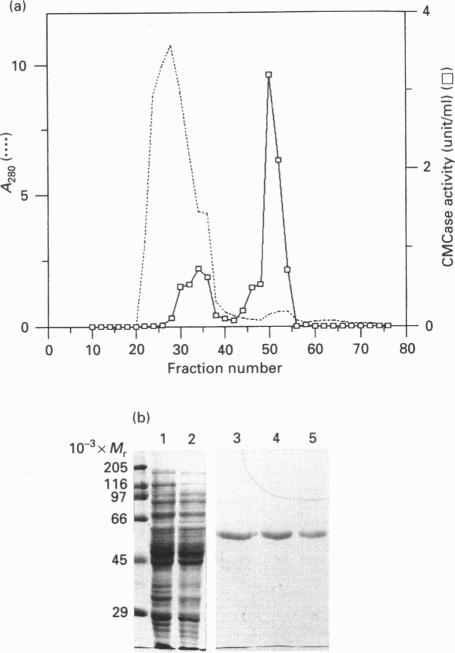
A genomic library of Pseudomonas fluorescens subsp. cellulosa DNA, constructed in lambda ZAPII, was screened for carboxymethyl-cellulase activity. The pseudomonad insert from a recombinant phage which displayed elevated cellulase activity in comparison with other cellulase-positive clones present in the library, was excised into pBluescript SK- to generate the plasmid pC48. The nucleotide sequence of the cellulase gene, designated celE, revealed a single open reading frame of 1710 bp that encoded a polypeptide, defined as endoglucanase E (CelE), of M(r) 59663. The deduced primary structure of CelE revealed an N-terminal signal peptide followed by a 300-amino-acid sequence that exhibited significant identity with the catalytic domains of cellulases belonging to glycosyl hydrolase Family 5. Adjacent to the catalytic domain was a 40-residue region that exhibited strong sequence identity to non-catalytic domains located in two other endoglucanases and a xylanase from P. fluorescens. The C-terminal 100 residues of CelE were similar to Type-I cellulose-binding domains (CBDs). The three domains of the cellulase were joined by linker sequences rich in serine residues. Analysis of the biochemical properties of full-length and truncated derivatives of CelE confirmed that the enzyme comprised an N-terminal catalytic domain and a C-terminal CBD. Analysis of purified CelE revealed that the enzyme had an M(r) of 56000 and an experimentally determined N-terminal sequence identical to residues 40-54 of the deduced primary structure of full-length CelE. The enzyme exhibited an endo mode of action in hydrolysing a range of cellulosic substrates including Avicel and acid-swollen cellulose, but did not attack xylan or any other hemicelluloses. A truncated form of the enzyme, which lacked the C-terminal CBD, displayed the same activity as full-length CelE against soluble cellulose and acid-swollen cellulose, but exhibited substantially lower activity than the full-length cellulase against Avicel. The significance of these data in relation to the role of the CBD is discussed.
构建于λZAPII中的荧光假单胞菌纤维素亚种(Pseudomonas fluorescens subsp. cellulosa)DNA基因组文库,经筛选具有羧甲基纤维素酶活性。与文库中其他纤维素酶阳性克隆相比,一个重组噬菌体中的假单胞菌插入片段显示出更高的纤维素酶活性,将其切出并插入到pBluescript SK-中,构建成质粒pC48。纤维素酶基因(命名为celE)的核苷酸序列显示,有一个1710 bp的单一开放阅读框,编码一个分子量为59663的多肽,定义为内切葡聚糖酶E(CelE)。CelE推导的一级结构显示,其N端有一个信号肽,随后是一个300个氨基酸的序列,该序列与属于糖基水解酶家族5的纤维素酶催化结构域有显著同源性。与催化结构域相邻的是一个40个残基的区域,与荧光假单胞菌的另外两种内切葡聚糖酶和一种木聚糖酶中的非催化结构域有很强的序列同源性。CelE的C端100个残基与I型纤维素结合结构域(CBD)相似。纤维素酶的这三个结构域由富含丝氨酸残基的连接序列相连。对CelE全长及截短衍生物的生化特性分析证实,该酶由一个N端催化结构域和一个C端CBD组成。对纯化后的CelE分析表明,该酶的分子量为56000,实验测定的N端序列与全长CelE推导一级结构的40-54位残基相同。该酶在水解包括微晶纤维素和酸膨胀纤维素在内的一系列纤维素底物时表现出内切作用模式,但不作用于木聚糖或任何其他半纤维素。一种缺少C端CBD的截短形式的酶,对可溶性纤维素和酸膨胀纤维素的活性与全长CelE相同,但对微晶纤维素的活性比全长纤维素酶低得多。讨论了这些数据与CBD作用的相关性。