Voelker R, Barkan A
Institute of Molecular Biology, University of Oregon, Eugene 97403, USA.
EMBO J. 1995 Aug 15;14(16):3905-14. doi: 10.1002/j.1460-2075.1995.tb00062.x.
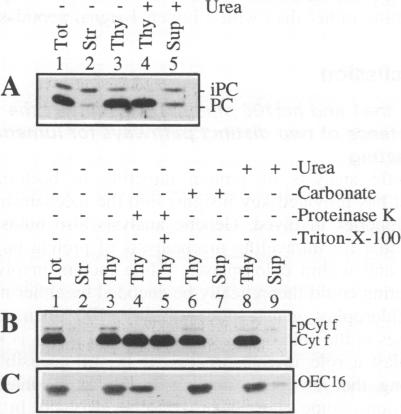
Results of in vitro experiments have suggested the existence of at least three pathways by which nuclear-encoded proteins are targeted to the chloroplast thylakoid membrane. However, few components of the targeting machinery have been identified and the relationship between the three pathways is not clear. To investigate mechanisms underlying thylakoid protein targeting, we identified nuclear mutations in maize that cause targeting defects. We found two mutations, tha1 and hcf106, that disrupt the localization of different sets of proteins to the thylakoid lumen. The tha1 mutation interferes with the targeting of one chloroplast-encoded protein, cytochrome f, and three nuclear-encoded proteins, plastocyanin, the psaF gene product and the 33 kDa subunit of the oxygen-evolving complex. The hcf106 mutation interferes with the targeting of the 16 and 23 kDa subunits of the oxygen-evolving complex. The tha1 and hcf106 phenotypes provide the first in vivo evidence supporting the existence of two distinct thylakoid-targeting pathways. Their phenotypes also provide evidence that one chloroplast-encoded protein, cytochrome f, engages the 'tha1' pathway, indicating that nuclear- and chloroplast-encoded proteins can be targeted via common machinery.
体外实验结果表明,核编码蛋白至少通过三条途径被靶向运输到叶绿体类囊体膜。然而,靶向运输机制中已确定的组分很少,且这三条途径之间的关系尚不清楚。为了研究类囊体蛋白靶向运输的潜在机制,我们在玉米中鉴定出了导致靶向运输缺陷的核突变。我们发现了两个突变体,tha1和hcf106,它们破坏了不同蛋白质组向类囊体腔的定位。tha1突变干扰了一种叶绿体编码蛋白细胞色素f以及三种核编码蛋白质体蓝素、psaF基因产物和放氧复合体33 kDa亚基的靶向运输。hcf106突变干扰了放氧复合体16 kDa和23 kDa亚基的靶向运输。tha1和hcf106的表型提供了首个体内证据,支持存在两条不同的类囊体靶向运输途径。它们的表型还提供了证据,表明一种叶绿体编码蛋白细胞色素f参与了“tha1”途径,这表明核编码和叶绿体编码的蛋白可以通过共同的机制进行靶向运输。