van Corven E J, Hordijk P L, Medema R H, Bos J L, Moolenaar W H
Division of Cellular Biochemistry, The Netherlands Cancer Institute, Amsterdam.
Proc Natl Acad Sci U S A. 1993 Feb 15;90(4):1257-61. doi: 10.1073/pnas.90.4.1257.
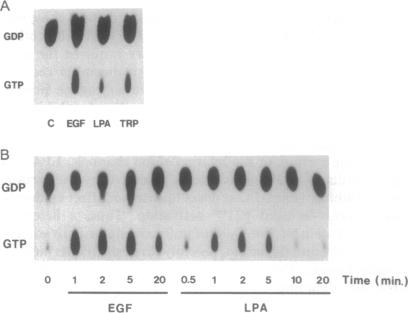
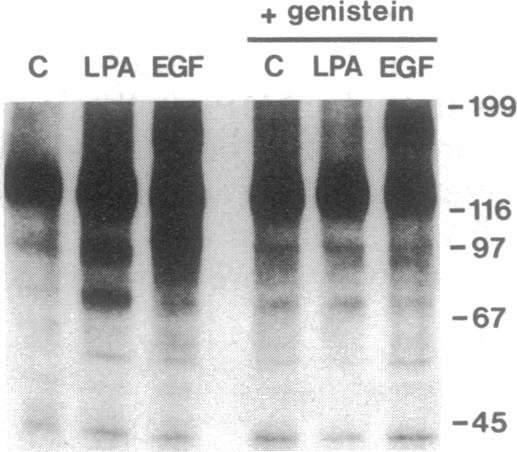
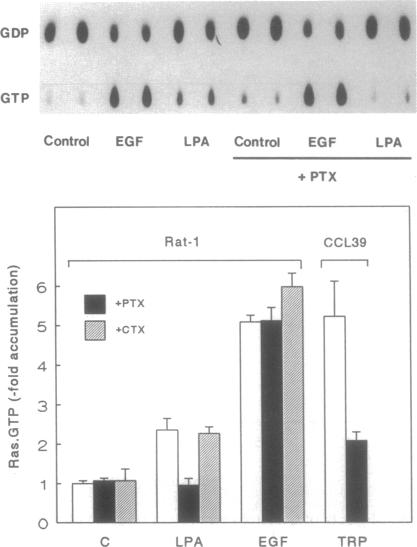
Some agonists of G protein-coupled receptors, such as thrombin and lysophosphatidic acid (LPA), can promote cell proliferation via a pertussis toxin (PTX)-sensitive signaling pathway. While these agonists stimulate phospholipase C and inhibit adenylate cyclase, it appears that other, as-yet-unidentified, effector pathways are required for mitogenesis. Here we report that LPA and a thrombin receptor agonist peptide rapidly activate the protooncogene product p21ras in quiescent fibroblasts. This activation is inhibited by PTX and yet not attributable to known PTX-sensitive G protein pathways, including stimulation of phospholipases, inhibition of adenylate cyclase, or modulation of ion channels. LPA- and peptide-induced p21ras activation is inhibited by the tyrosine kinase inhibitor genistein, at doses that do not affect epidermal growth factor-induced p21ras activation. Thus, a heterotrimeric G protein of the Gi subfamily regulates activation of p21ras by LPA and thrombin, possibly through an intermediary tyrosine kinase. This pathway may critically participate in mitogenic signaling downstream from certain G protein-coupled receptors.
一些G蛋白偶联受体的激动剂,如凝血酶和溶血磷脂酸(LPA),可通过百日咳毒素(PTX)敏感的信号通路促进细胞增殖。虽然这些激动剂刺激磷脂酶C并抑制腺苷酸环化酶,但似乎有其他尚未明确的效应器通路参与有丝分裂原的产生。在此我们报告,LPA和凝血酶受体激动剂肽可在静止的成纤维细胞中迅速激活原癌基因产物p21ras。这种激活被PTX抑制,但并非归因于已知的PTX敏感G蛋白通路,包括磷脂酶的刺激、腺苷酸环化酶的抑制或离子通道的调节。LPA和肽诱导的p21ras激活被酪氨酸激酶抑制剂染料木黄酮抑制,其剂量不影响表皮生长因子诱导的p21ras激活。因此,Gi亚家族的异源三聚体G蛋白可能通过中间酪氨酸激酶调节LPA和凝血酶对p21ras的激活。该通路可能在某些G蛋白偶联受体下游的有丝分裂信号传导中起关键作用。