Kocisko D A, Priola S A, Raymond G J, Chesebro B, Lansbury P T, Caughey B
Laboratory of Persistent Viral Diseases, Rocky Mountain Laboratories, National Institute of Allergies and Infectious Diseases, Hamilton, MT 59840,USA.
Proc Natl Acad Sci U S A. 1995 Apr 25;92(9):3923-7. doi: 10.1073/pnas.92.9.3923.
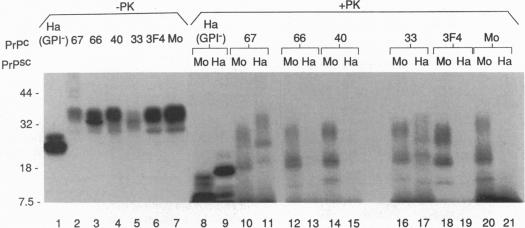
Scrapie is a transmissible neurodegenerative disease that appears to result from an accumulation in the brain of an abnormal protease-resistant isoform of prion protein (PrP) called PrPsc. Conversion of the normal, protease-sensitive form of PrP (PrPc) to protease-resistant forms like PrPsc has been demonstrated in a cell-free reaction composed largely of hamster PrPc and PrPsc. We now report studies of the species specificity of this cell-free reaction using mouse, hamster, and chimeric PrP molecules. Combinations of hamster PrPc with hamster PrPsc and mouse PrPc with mouse PrPsc resulted in the conversion of PrPc to protease-resistant forms. Protease-resistant PrP species were also generated in the nonhomologous reaction of hamster PrPc with mouse PrPsc, but little conversion was observed in the reciprocal reaction. Glycosylation of the PrPc precursors was not required for species specificity in the conversion reaction. The relative conversion efficiencies correlated with the relative transmissibilities of these strains of scrapie between mice and hamsters. Conversion experiments performed with chimeric mouse/hamster PrPc precursors indicated that differences between PrPc and PrPsc at residues 139, 155, and 170 affected the conversion efficiency and the size of the resultant protease-resistant PrP species. We conclude that there is species specificity in the cell-free interactions that lead to the conversion of PrPc to protease-resistant forms. This specificity may be the molecular basis for the barriers to interspecies transmission of scrapie and other transmissible spongiform encephalopathies in vivo.
羊瘙痒症是一种可传播的神经退行性疾病,似乎是由一种异常的、抗蛋白酶的朊病毒蛋白(PrP)异构体(称为PrPsc)在大脑中积累所致。在一个主要由仓鼠PrPc和PrPsc组成的无细胞反应中,已证明正常的、蛋白酶敏感形式的PrP(PrPc)可转化为抗蛋白酶形式,如PrPsc。我们现在报告使用小鼠、仓鼠和嵌合PrP分子对这种无细胞反应的物种特异性进行的研究。仓鼠PrPc与仓鼠PrPsc以及小鼠PrPc与小鼠PrPsc的组合导致PrPc转化为抗蛋白酶形式。在仓鼠PrPc与小鼠PrPsc的异源反应中也产生了抗蛋白酶的PrP物种,但在反向反应中观察到的转化很少。转化反应中的物种特异性不需要PrPc前体的糖基化。相对转化效率与这些羊瘙痒症毒株在小鼠和仓鼠之间的相对传播性相关。用嵌合小鼠/仓鼠PrPc前体进行的转化实验表明,PrPc和PrPsc在第139、155和170位残基处的差异影响了转化效率和所得抗蛋白酶PrP物种的大小。我们得出结论,在导致PrPc转化为抗蛋白酶形式的无细胞相互作用中存在物种特异性。这种特异性可能是羊瘙痒症和其他可传播海绵状脑病在体内种间传播障碍的分子基础。