Bergin P S, Fish D R, Shorvon S D, Oatridge A, deSouza N M, Bydder G M
Institute of Neurology, National Hospital for Neurology and Neurosurgery, Queen Square, London, UK.
J Neurol Neurosurg Psychiatry. 1995 Apr;58(4):439-43. doi: 10.1136/jnnp.58.4.439.
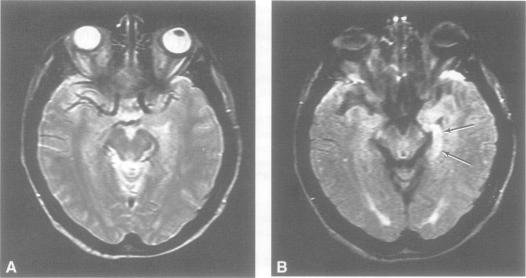
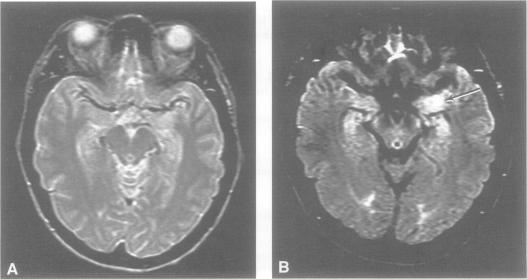
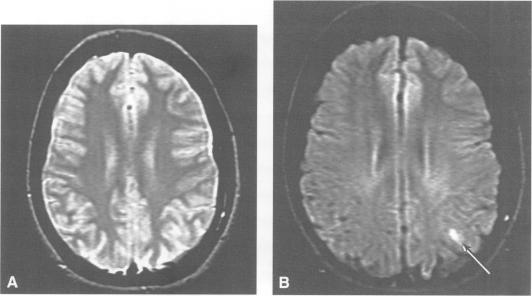
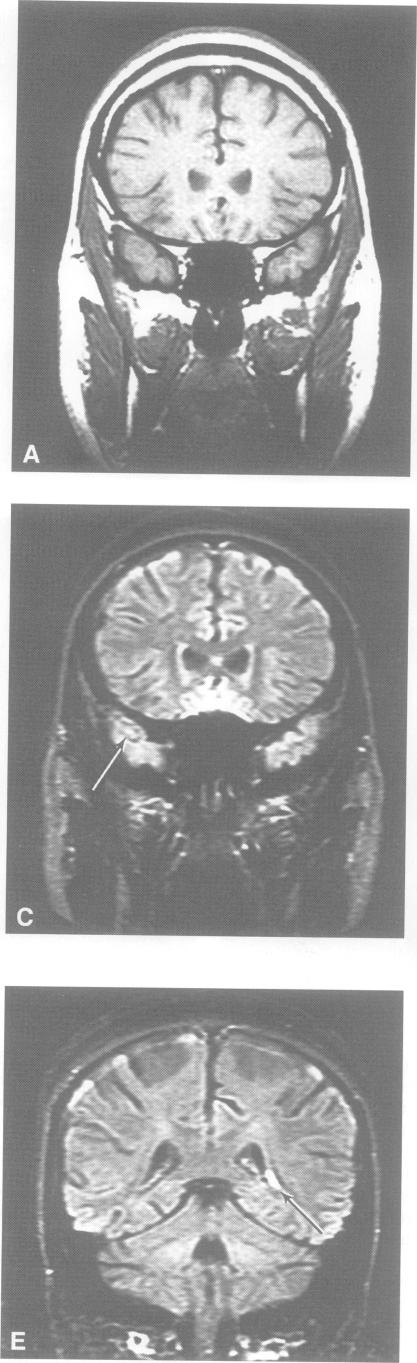
Thirty six patients with a history of partial epilepsy had MRI of the brain performed with conventional T1 and T2 weighted pulse sequences as well as the fluid attenuated inversion recovery (FLAIR) sequence. Abnormalities were found in 20 cases (56%), in whom there were 25 lesions or groups of lesions. Twenty four of these lesions were more conspicuous with the FLAIR sequence than with any of the conventional sequences. In 11 of these 20 cases, lesions thought to be of aetiological importance were only seen with the FLAIR sequence. In eight this was a solitary lesion. In the other three, an additional and apparently significant lesion (or lesions) was only seen with the FLAIR sequence when another lesion had been identified with both conventional and FLAIR sequences. The 11 additional lesions or groups of lesions were seen in the hippocampus, amygdala, cortex, or subcortical and periventricular regions. No lesion was found with any pulse sequence in 16 (44%) of the original group of 36 patients. In the eight cases where a lesion was seen only with the FLAIR sequence, localisation was concordant with the electroclinical features. Two of the eight patients with solitary lesions seen only on the FLAIR sequence underwent surgery, after which there was pathological confirmation of the abnormality identified with imaging. In one patient with a congenital cavernoma, the primary lesion was best seen with a contrast enhanced T1 weighted spin echo sequence. In this selected series, the FLAIR sequence increased the yield of MRI examinations of the brain by 30%.
36例有部分性癫痫病史的患者接受了脑部MRI检查,采用传统的T1加权和T2加权脉冲序列以及液体衰减反转恢复(FLAIR)序列。20例(56%)发现异常,其中有25个病灶或病灶群。这些病灶中有24个在FLAIR序列上比在任何传统序列上更明显。在这20例中的11例中,被认为具有病因学重要性的病灶仅在FLAIR序列上可见。其中8例为单个病灶。在另外3例中,当另一个病灶在传统序列和FLAIR序列上均被识别出来时,一个额外的且明显有意义的病灶(或多个病灶)仅在FLAIR序列上可见。这11个额外的病灶或病灶群见于海马体、杏仁核、皮质或皮质下及脑室周围区域。在最初的36例患者中,16例(44%)在任何脉冲序列上均未发现病灶。在仅在FLAIR序列上发现病灶的8例中,病灶定位与电临床特征一致。仅在FLAIR序列上发现单个病灶的8例患者中有2例接受了手术,术后病理证实了影像学上发现的异常。在1例先天性海绵状血管瘤患者中,主要病灶在对比增强T1加权自旋回波序列上显示最佳。在这个选定的系列中,FLAIR序列使脑部MRI检查的检出率提高了30%。