Bahadori L, Milder J, Gold L, Botney M
Respiratory and Critical Care Division, Jewish Hospital, Washington University Medical Center, St. Louis, MO 63110, USA.
Am J Pathol. 1995 May;146(5):1140-9.
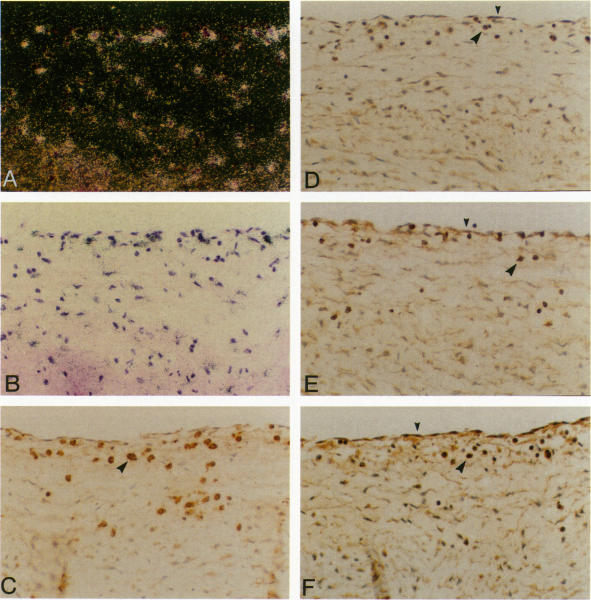
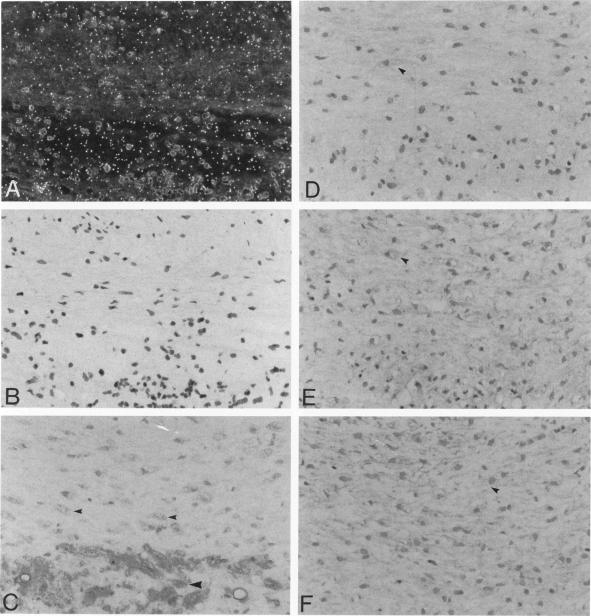
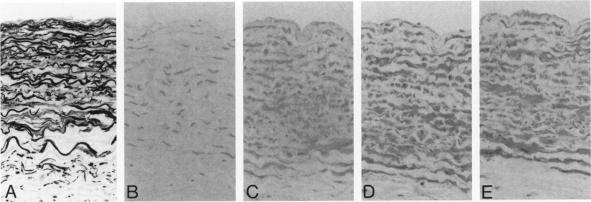
Vascular remodeling in adult atherosclerotic pulmonary arteries is characterized by discrete areas of neointimal smooth muscle cell extracellular matrix gene expression in close proximity to non-foamy macrophages, suggesting regulation by local macrophage-associated factors. The purpose of these studies was to begin addressing the role of putative macrophage-associated factors such as transforming growth factor-beta (TGF-beta), by determining the spatial relationship between TGF-beta and neointimal matrix gene expression in human atherosclerotic pulmonary arteries. For example, the participation of TGF-beta in vascular remodeling could be inferred by its colocalization with non-foamy macrophages in areas of active matrix synthesis. In situ hybridization and immunohistochemistry demonstrated focal neointimal procollagen gene expression in close association with non-foamy but not foamy macrophages. Immunohistochemistry with isoform-specific anti-TGF-beta antibodies demonstrated all three isoforms of TGF-beta associated with non-foamy macrophages, but foamy macrophages were not immunoreactive. Neointimal and medial smooth muscle cells stained lightly. In contrast, intense TGF-beta immunoreactivity was also associated with medial smooth muscle cells in normal nonremodeling vessels. Immunohistochemistry with antibodies specific for latent TGF-beta was similar to immunohistochemistry for mature TGF-beta in both remodeling and nonremodeling vessels. Finally, using an antibody specific for active TGF-beta 1, immunoreactivity was only seen in non-foamy neointimal macrophages but not in foamy macrophages or medial smooth muscle cells from hypertensive or normal vessels. These observations suggest non-foamy macrophages may participate in modulating matrix gene expression in atherosclerotic remodeling via a TGF-beta-dependent mechanism.
成人动脉粥样硬化性肺动脉的血管重塑特征为,在紧邻非泡沫巨噬细胞处有离散的新生内膜平滑肌细胞外基质基因表达区域,提示其受局部巨噬细胞相关因子调控。这些研究的目的是,通过确定转化生长因子-β(TGF-β)与人动脉粥样硬化性肺动脉新生内膜基质基因表达之间的空间关系,开始探讨诸如TGF-β等假定的巨噬细胞相关因子的作用。例如,TGF-β参与血管重塑可通过其在活性基质合成区域与非泡沫巨噬细胞共定位来推断。原位杂交和免疫组化显示,新生内膜原胶原基因表达灶与非泡沫而非泡沫巨噬细胞密切相关。用亚型特异性抗TGF-β抗体进行免疫组化显示,TGF-β的所有三种亚型均与非泡沫巨噬细胞相关,但泡沫巨噬细胞无免疫反应性。新生内膜和中膜平滑肌细胞染色浅。相比之下,在正常未重塑血管中,中膜平滑肌细胞也有强烈的TGF-β免疫反应性。在重塑和未重塑血管中,用潜伏TGF-β特异性抗体进行的免疫组化与成熟TGF-β的免疫组化相似。最后,使用活性TGF-β1特异性抗体,仅在非泡沫新生内膜巨噬细胞中见到免疫反应性,而在高血压或正常血管的泡沫巨噬细胞或中膜平滑肌细胞中未见到。这些观察结果表明,非泡沫巨噬细胞可能通过TGF-β依赖性机制参与调节动脉粥样硬化重塑中的基质基因表达。