Sneppen K, Bak P, Flyvbjerg H, Jensen M H
Department of Physics, Princeton University, NJ 08544-0708, USA.
Proc Natl Acad Sci U S A. 1995 May 23;92(11):5209-13. doi: 10.1073/pnas.92.11.5209.
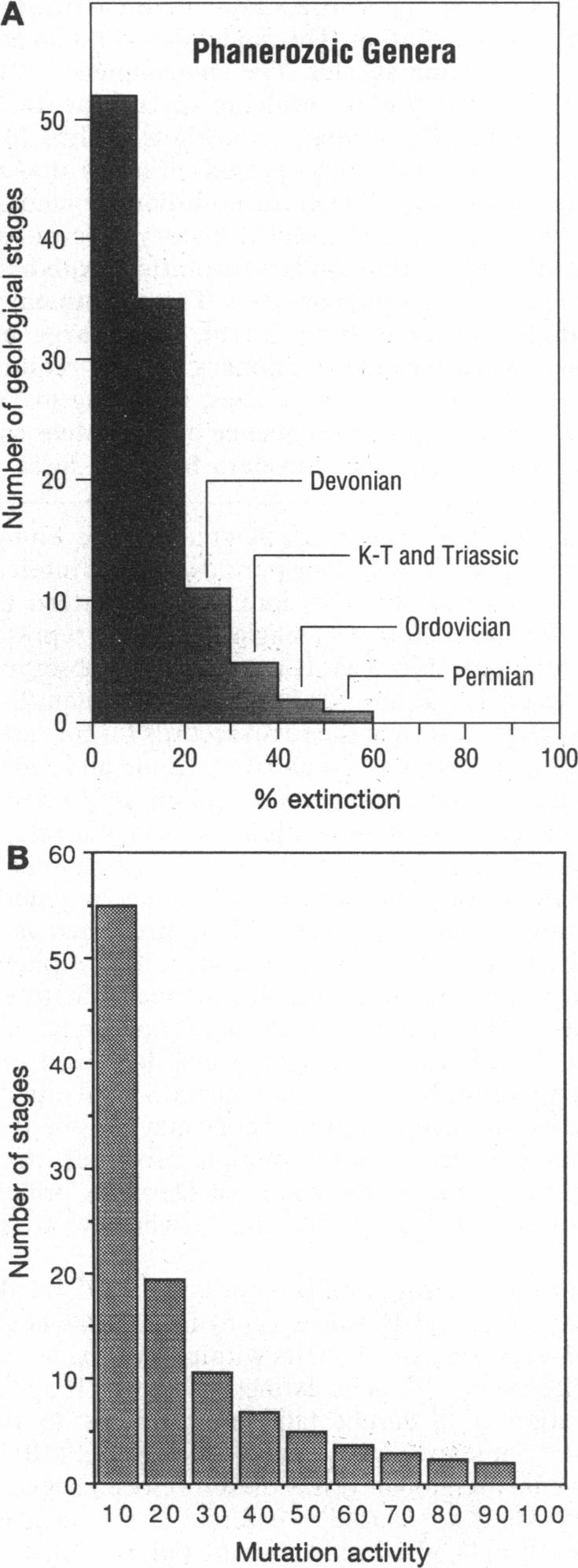
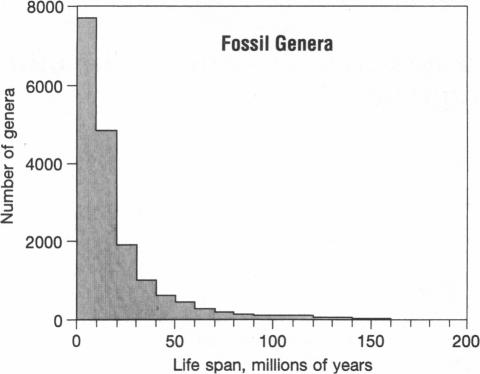
We present a simple mathematical model of biological macroevolution. The model describes an ecology of adapting, interacting species. The environment of any given species is affected by other evolving species; hence, it is not constant in time. The ecology as a whole evolves to a "self-organized critical" state where periods of stasis alternate with avalanches of causally connected evolutionary changes. This characteristic behavior of natural history, known as "punctuated equilibrium," thus finds a theoretical explanation as a self-organized critical phenomenon. The evolutionary behavior of single species is intermittent. Also, large bursts of apparently simultaneous evolutionary activity require no external cause. Extinctions of all sizes, including mass extinctions, may be a simple consequence of ecosystem dynamics. Our results are compared with data from the fossil record.
我们提出了一个生物宏观进化的简单数学模型。该模型描述了适应性相互作用物种的生态。任何给定物种的环境都会受到其他不断进化的物种的影响;因此,它在时间上不是恒定的。作为一个整体的生态系统会进化到一种“自组织临界”状态,在这种状态下,停滞期与因果相关的进化变化的雪崩交替出现。自然历史的这种特征行为,即“间断平衡”,因此作为一种自组织临界现象找到了理论解释。单个物种的进化行为是间歇性的。此外,大量明显同时发生的进化活动爆发不需要外部原因。各种规模的灭绝,包括大规模灭绝,可能只是生态系统动态变化的简单结果。我们将结果与化石记录的数据进行了比较。