Jeon S, Lambert P F
McArdle Laboratory for Cancer Research, University of Wisconsin Medical School, Madison 53706.
Proc Natl Acad Sci U S A. 1995 Feb 28;92(5):1654-8. doi: 10.1073/pnas.92.5.1654.
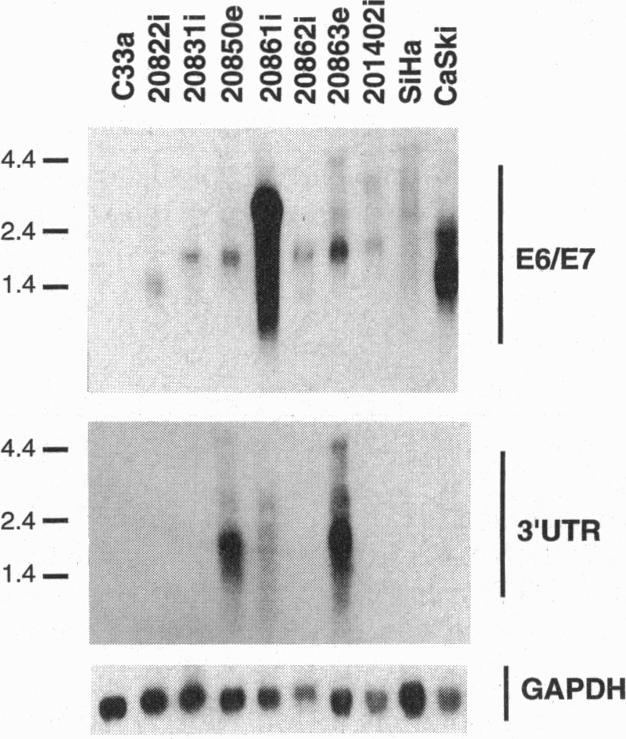
In many cervical cancers, human papillomavirus type 16 (HPV-16) DNA genomes are found to be integrated into the host chromosome. In this study, we demonstrate that integration of HPV-16 DNA leads to increased steady-state levels of mRNAs encoding the viral oncogenes E6 and E7. This increase is shown to result, at least in part, from an increased stability of E6 and E7 mRNAs that arise specifically from those integrated viral genomes disrupted in the 3' untranslated region of the viral early region. Further, we demonstrate that the A+U-rich element within this viral early 3' untranslated region confers instability on a heterologous mRNA. We conclude that integration of HPV-16 DNA, as occurs in cervical cancers, can result in the increased expression of the viral E6 and E7 oncogenes through altered mRNA stability.
在许多宫颈癌中,发现人乳头瘤病毒16型(HPV - 16)DNA基因组整合到宿主染色体中。在本研究中,我们证明HPV - 16 DNA的整合导致编码病毒癌基因E6和E7的mRNA稳态水平增加。这种增加至少部分是由于E6和E7 mRNA稳定性增加所致,这些mRNA特别来源于那些在病毒早期区域3'非翻译区中断的整合病毒基因组。此外,我们证明该病毒早期3'非翻译区内富含A + U的元件赋予异源mRNA不稳定性。我们得出结论,如在宫颈癌中发生的HPV - 16 DNA整合可通过改变mRNA稳定性导致病毒E6和E7癌基因表达增加。