Chuluyan H E, Issekutz A C
Department of Pediatrics, Dalhousie University, Halifax, Nova Scotia, Canada.
J Clin Invest. 1993 Dec;92(6):2768-77. doi: 10.1172/JCI116895.
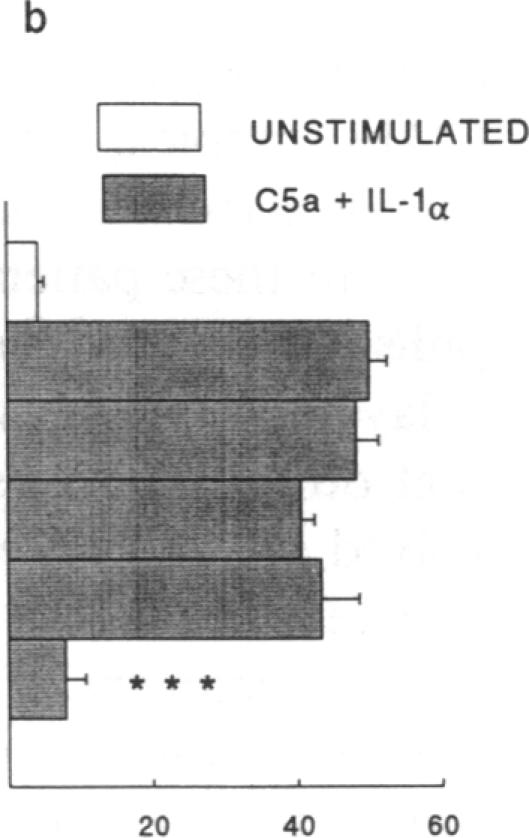
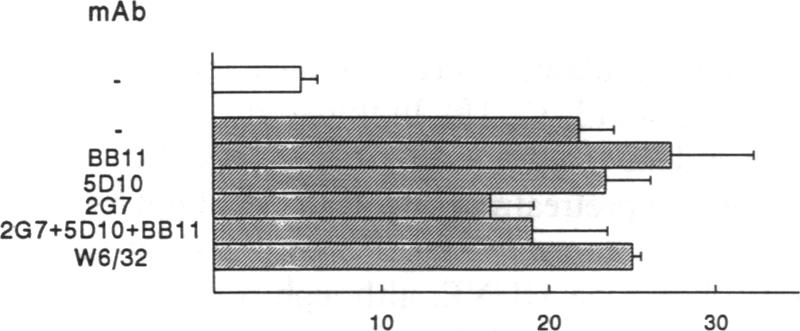
The migration of human monocytes across unactivated and activated human umbilical vein endothelium (HUVE) in response to chemotactic factors was studied, and the adhesion molecules involved were characterized. Migration of blood monocytes or U937 cell line-derived monocytes across unactivated HUVE induced by C5a, was partially inhibited (by 75%) by mAbs (R15.7 or 60.3) to CD18 of the CD11/CD18 complex on the monocyte. However, when the HUVE was pretreated for 5 h with IL-1 alpha (0.1 ng/ml), TNF-alpha (100 U/ml), or LPS (1 ng/ml), migration induced by C5a was no longer inhibited; i.e., migration became CD18 independent. The monocyte CD18-independent migration was completely blocked by mAbs against alpha 4 or beta 1 integrin chains of VLA-4. This migration was also partially inhibited by mAbs against vascular cell adhesion molecule-1 (VCAM-1), a major counter-receptor on HUVE for VLA-4, but not by mAbs to E-selectin or intercellular adhesion molecule-1. The significant CD18-independent migration across "unactivated" HUVE was also inhibited by mAbs against alpha 4 or beta 1 chains of VLA-4, although mAbs against VCAM-1 did not inhibit under these conditions. Finally, considerable VLA-4-dependent transendothelial migration to C5a was also observed with monocytes from a patient with CD18 deficiency (leukocyte adhesion deficiency). These results suggest that (a) there is a major CD18-independent component in monocyte chemotactic factor-dependent migration across activated and unactivated endothelium; (b) that VLA-4 integrin on the monocyte has a major role in this migration; and (c) that VCAM-1 on activated endothelium functions as a counter-receptor in this process, but other ligands for VLA-4, especially on unactivated endothelium, may also be involved.
研究了人单核细胞在趋化因子作用下穿过未活化和活化的人脐静脉内皮细胞(HUVE)的迁移情况,并对其中涉及的黏附分子进行了表征。血液单核细胞或U937细胞系来源的单核细胞在C5a诱导下穿过未活化HUVE的迁移,被针对单核细胞上CD11/CD18复合物中CD18的单克隆抗体(R15.7或60.3)部分抑制(75%)。然而,当HUVE用IL-1α(0.1 ng/ml)、TNF-α(100 U/ml)或LPS(1 ng/ml)预处理5小时后,C5a诱导的迁移不再被抑制;即迁移变得不依赖CD18。单核细胞不依赖CD18的迁移被针对VLA-4的α4或β1整合素链的单克隆抗体完全阻断。这种迁移也被针对血管细胞黏附分子-1(VCAM-1)的单克隆抗体部分抑制,VCAM-1是HUVE上VLA-4的主要反受体,但不被针对E-选择素或细胞间黏附分子-1的单克隆抗体抑制。在“未活化”HUVE上显著的不依赖CD18的迁移也被针对VLA-4的α4或β1链的单克隆抗体抑制,尽管在这些条件下针对VCAM-1的单克隆抗体没有抑制作用。最后,在一名CD18缺陷(白细胞黏附缺陷)患者的单核细胞中也观察到了相当数量的依赖VLA-4的跨内皮迁移至C5a。这些结果表明:(a)在单核细胞趋化因子依赖的穿过活化和未活化内皮的迁移中存在一个主要的不依赖CD18的成分;(b)单核细胞上的VLA-4整合素在这种迁移中起主要作用;(c)活化内皮上的VCAM-1在这个过程中作为反受体发挥作用,但VLA-4的其他配体,特别是在未活化内皮上的配体,可能也参与其中。