Wu J C, Merlino G, Fausto N
Department of Pathology and Laboratory Medicine, Brown University, Providence, RI 02912.
Proc Natl Acad Sci U S A. 1994 Jan 18;91(2):674-8. doi: 10.1073/pnas.91.2.674.
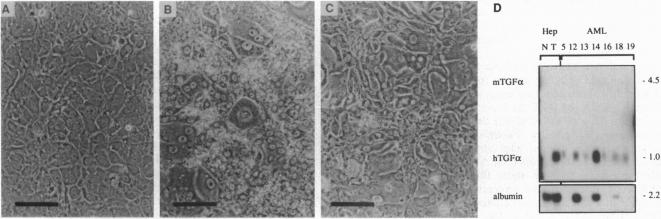
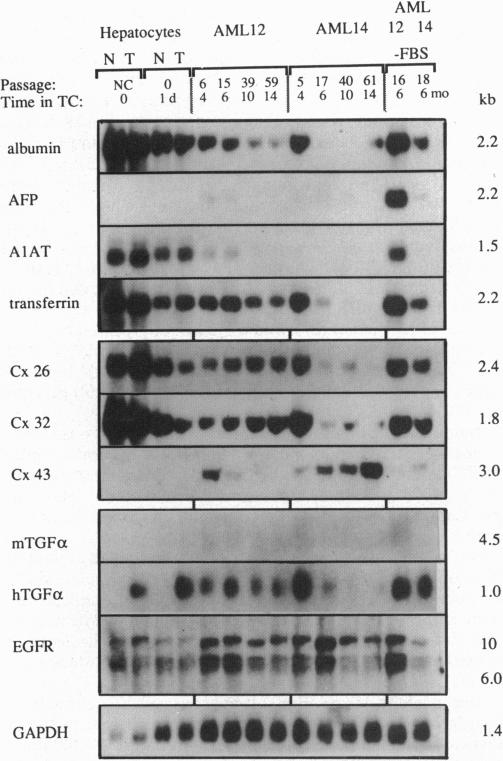
Hepatocytes are extensively used in studies of gene regulation but cannot be maintained in long-term culture as replicating, differentiated cells while remaining nontumorigenic. We have derived two hepatocyte lines from livers of transgenic mice overexpressing transforming growth factor alpha, a potent hepatocyte mitogen, which overcome these limitations. The transgenic hepatocytes were maintained for > or = 2 months in serum-supplemented primary culture and gave rise to cell lines, of which two (AML12 and AML14) have been cultured for > 1.5 years (> 80 passages). Both lines have typical hepatocyte features such as peroxisomes and bile canalicular-like structures, do not grow in soft agar, and are nontumorigenic in nude mice. Like normal hepatocytes, AML cells express high levels of mRNA for serum (albumin, alpha 1-antitrypsin, and transferrin) and gap junction (connexins 26 and 32) proteins, secrete albumin, and contain solely isozyme 5 of lactate dehydrogenase. After extensive passaging, AML12 cells continue to strongly coexpress hepatocyte connexin mRNAs but do not display nonparenchymal cell markers. Although mRNA levels for some serum proteins progressively fall, high expression in late AML12 cultures may be regained by passage in serum-free medium. The AML14 line loses expression of both differentiated markers and transgene mRNA with extended passaging, and hepatocytic traits are only partially restored by passage in serum-free medium. These differentiated, nontumorigenic cell lines should serve as models in which to study hepatocyte growth and differentiation.
肝细胞在基因调控研究中被广泛应用,但无法作为具有复制能力、分化状态且保持非致瘤性的细胞进行长期培养。我们从过表达转化生长因子α(一种强效的肝细胞有丝分裂原)的转基因小鼠肝脏中获得了两种肝细胞系,克服了这些限制。转基因肝细胞在添加血清的原代培养中维持了≥2个月,并产生了细胞系,其中两种(AML12和AML14)已培养超过1.5年(>80代)。这两种细胞系都具有典型的肝细胞特征,如过氧化物酶体和胆小管样结构,不在软琼脂中生长,且在裸鼠中不具有致瘤性。与正常肝细胞一样,AML细胞表达高水平的血清(白蛋白、α1-抗胰蛋白酶和转铁蛋白)和间隙连接(连接蛋白26和32)蛋白的mRNA,分泌白蛋白,且仅含有乳酸脱氢酶同工酶5。经过大量传代后,AML12细胞继续强烈共表达肝细胞连接蛋白mRNA,但不显示非实质细胞标记物。尽管一些血清蛋白的mRNA水平逐渐下降,但在无血清培养基中传代后,晚期AML12培养物中的高表达可能会恢复。AML14细胞系随着传代次数的增加会失去分化标记物和转基因mRNA的表达,并且在无血清培养基中传代只能部分恢复肝细胞特性。这些分化的、非致瘤性的细胞系应可作为研究肝细胞生长和分化的模型。