Witzgall R, Brown D, Schwarz C, Bonventre J V
Renal Unit, Medical Services, Massachusetts General Hospital East, Charlestown 02129.
J Clin Invest. 1994 May;93(5):2175-88. doi: 10.1172/JCI117214.
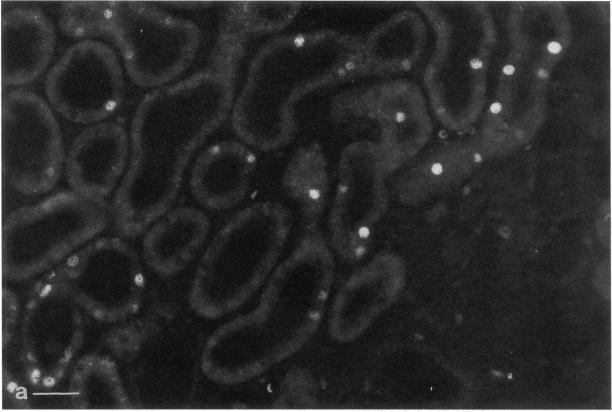
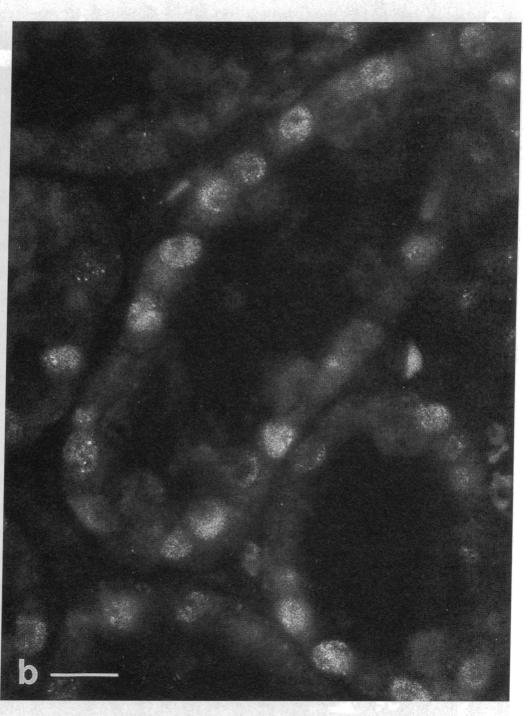
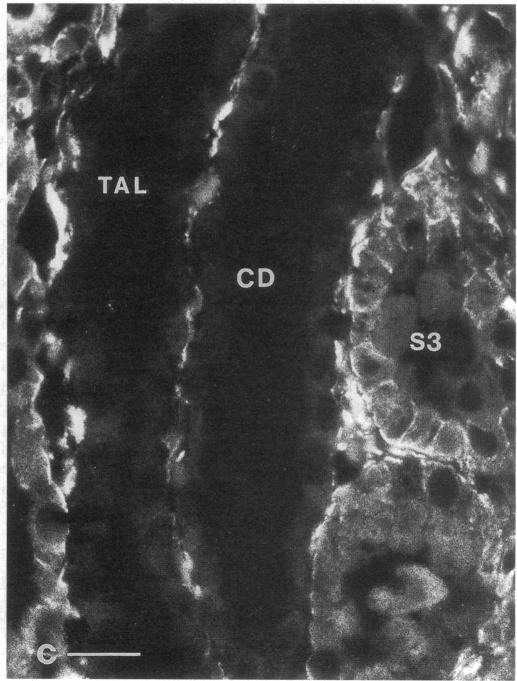
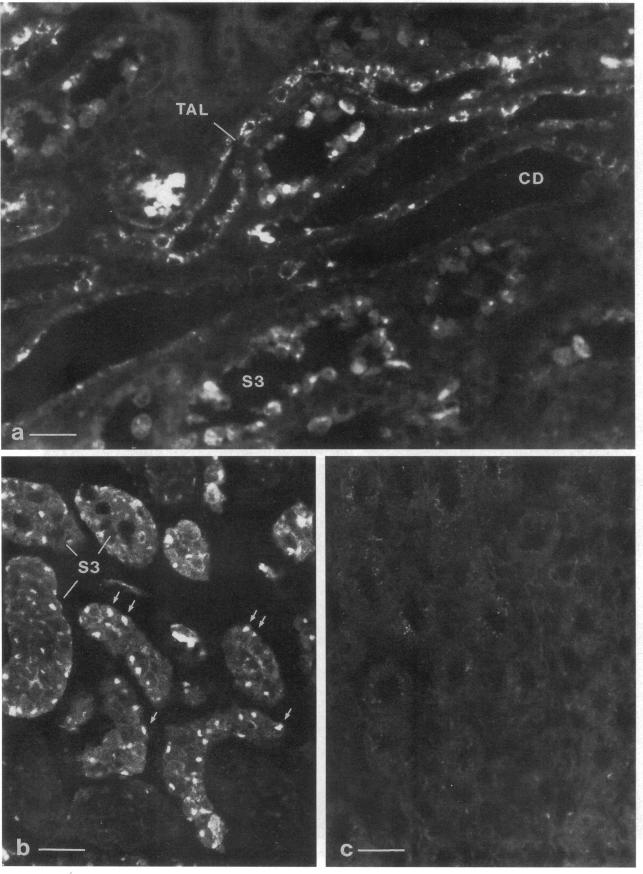
The mechanisms leading to the recovery of the kidney after ischemic acute renal failure are poorly understood. To explore the role played by mitogenesis and dedifferentiation in this repair process and to identify whether the genetic response of the nephron segments reflects the level of susceptibility to injury, the temporal and nephron segment expressions of various proteins implicated in mitogenesis, differentiation, and injury were determined. Proliferating cell nuclear antigen (PCNA), a marker for the G1-S transition in the cell cycle and hence mitogenesis, was detected primarily in the S3 segment of the proximal tubule, with maximal expression at 2 d postischemia. Vimentin, normally present in mesenchymal cells but not epithelial cells, and hence a marker for the state of differentiation, was prominently expressed in the S3 segment 2-5 d postischemia. In the S3 segments in the outer stripe of the medulla cells that stained positively for PCNA also stained positively for vimentin. Clusterin, a marker for cell injury, was expressed primarily in the S3 segment and in the distal tubule with distinct staining patterns in each segment. None of the cells that stained with clusterin antibodies were positively stained with PCNA or vimentin antibodies. Likewise, none of the PCNA or vimentin-positive cells expressed clusterin at detectable levels. Thus, in the S3 segment, where there is significant ischemic injury, surviving cells express markers indicating that they undergo mitogenesis and dedifferentiate in the postischemic period. While there is some expression of c-Fos in the S3 segment, c-Fos was expressed predominantly, at 1 and 3 h postischemia, in the nuclei of the distal nephron, particularly in the thick ascending limb. The data support the view that the mature renal S3 segment epithelial cell can be a progenitor cell.
缺血性急性肾衰竭后肾脏恢复的机制尚不清楚。为了探究有丝分裂和去分化在这一修复过程中所起的作用,并确定肾单位各节段的基因反应是否反映了对损伤的易感性水平,我们测定了参与有丝分裂、分化和损伤的各种蛋白质的时间和肾单位节段表达情况。增殖细胞核抗原(PCNA)是细胞周期中G1-S期转换的标志物,因此也是有丝分裂的标志物,主要在近端小管的S3节段中检测到,在缺血后2天表达量最高。波形蛋白通常存在于间充质细胞而非上皮细胞中,因此是分化状态的标志物,在缺血后2-5天在S3节段中显著表达。在髓质外带的S3节段中,对PCNA染色呈阳性的细胞对波形蛋白染色也呈阳性。聚集素是细胞损伤的标志物,主要在S3节段和远端小管中表达,且在每个节段中有不同的染色模式。用聚集素抗体染色的细胞均未被PCNA或波形蛋白抗体阳性染色。同样,PCNA或波形蛋白阳性的细胞也未检测到可检测水平的聚集素表达。因此,在存在严重缺血损伤的S3节段中,存活的细胞表达的标志物表明它们在缺血后期经历了有丝分裂和去分化。虽然S3节段中有一些c-Fos表达,但c-Fos在缺血后1小时和3小时主要在远端肾单位的细胞核中表达,特别是在厚壁升支中。这些数据支持成熟的肾S3节段上皮细胞可以是祖细胞的观点。