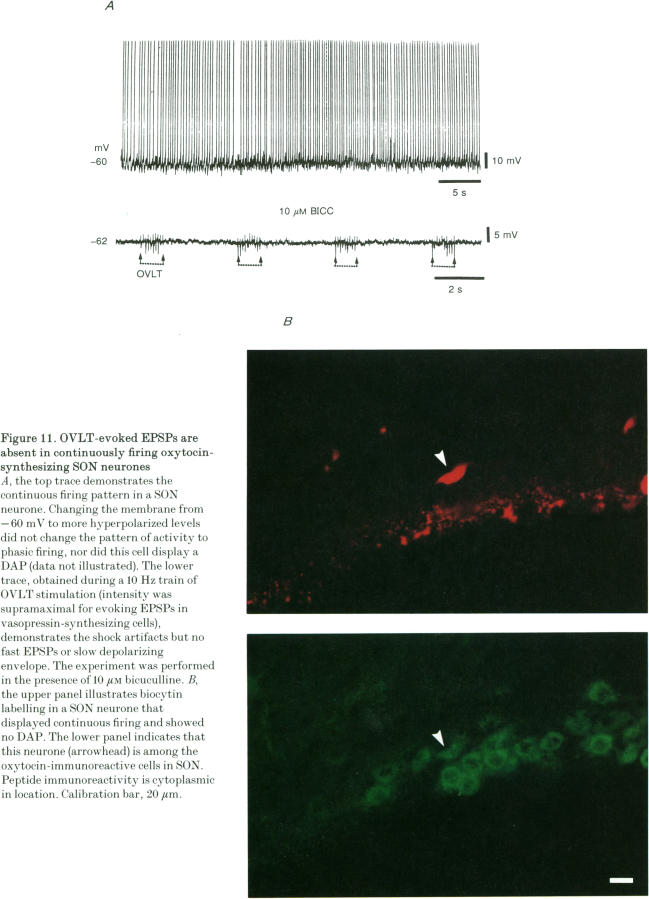
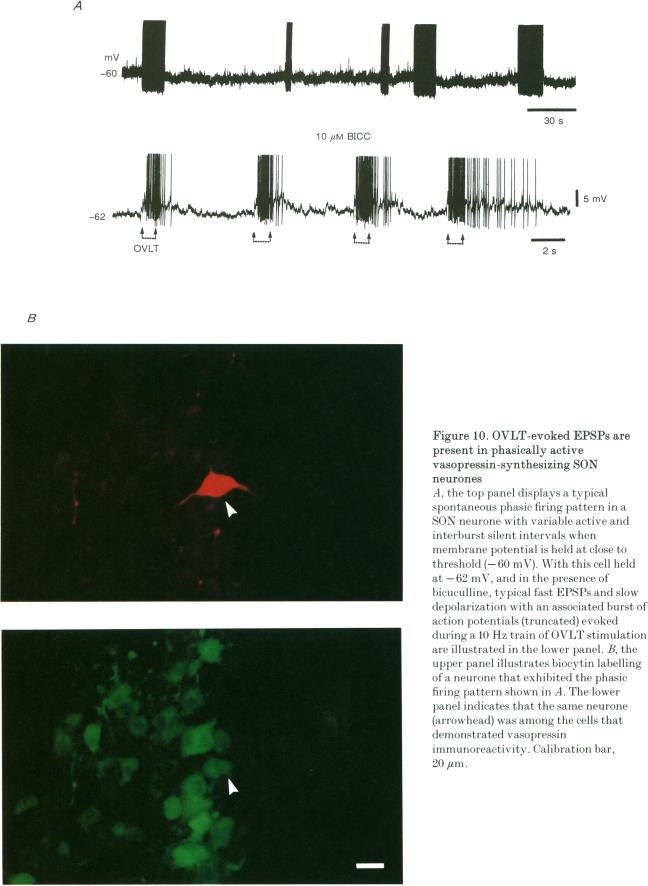
To characterize the organum vasculosum lamina terminalis (OVLT) innervation of hypothalamic supraoptic nucleus (SON) neurones, current clamp recordings were obtained in SON cells in superfused rat hypothalamic explants. Stimulation of 1 Hz evoked 5-10 mV bicuculline-sensitive IPSPs in forty out of forty-six SON neurones, including both phasic (vasopressin immunoreactive) and continuously firing (oxytocin immunoreactive) cells. 2. In twenty-four cells, mean IPSP latency was 8.7 +/- 1 ms (+/- S.D.) and reversal potentials (Vr) ranged between -60 and -75 mV. In the other sixteen cells, Vr ranged between -20 and -55 mV and the addition of bicuculline revealed underlying EPSPs (latency, 7.8 +/- 0.8 ms; mean Vr, -8 +/- 10 mV) with two components: (a) fast (rise and half-decay times of 5.83 +/- 1.3 ms and 19 +/- 4.4 ms respectively), with reversible blockade by 6-cyano-7-nitroquinoxaline-2,3-dione (CNQX); (b) slow (4- to 5-fold increase in rise and half-decay time), with reversible reduction by (-)-aminophosphonovaleric acid (APV). 3. During 10 Hz stimulation, EPSPs summated into 3-7 mV depolarizing envelopes lasting 1.5-3.0 s and sustaining action potential bursts. Depolarizing envelopes displayed voltage dependence, and were enhanced after removal of extracellular magnesium, diminished by APV and completely abolished by APV and CNQX together. 4. Thus, non-NMDA receptors probably mediate fast EPSPs whereas NMDA receptors mediate slow EPSPs and depolarizing envelopes. OVLT-evoked EPSPs were only seen in vasopressin-immunoreactive neurones. 5. These observations indicate converging inhibitory and target-selective excitatory amino acid-mediated inputs from OVLT to SON; the latter may modulate the excitability of SON vasopressin neurones to a hyperosmotic challenge.