Park B H, Matuschke B, Lavi E, Gaulton G N
Department of Pathology and Laboratory Medicine, University of Pennsylvania, Philadelphia 19104.
J Virol. 1994 Nov;68(11):7516-24. doi: 10.1128/JVI.68.11.7516-7524.1994.
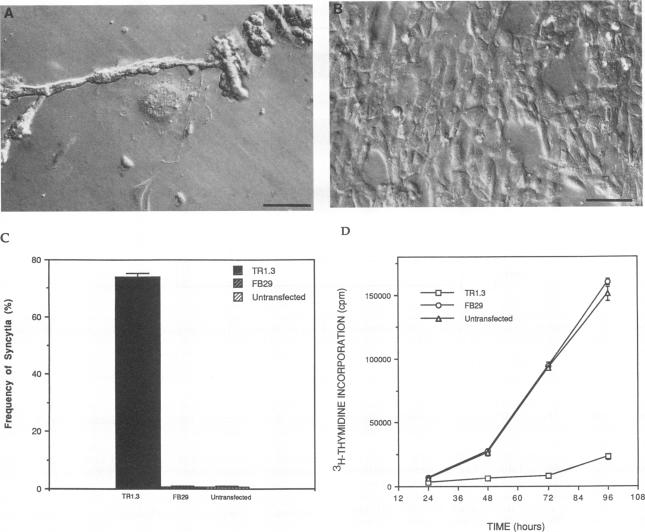
TR1.3 is a Friend-related murine leukemia virus that has been shown to cause intracerebral hemorrhages and neurologic disease due to infection and subsequent cytopathology of cerebral vessel endothelium. A striking feature of this pathology is the formation of endothelial cell syncytia. The pathogenesis of this disease has now been mapped to a single amino acid substitution of tryptophan to glycine in the variable region of the envelope protein. This same mutation enabled TR1.3 to form syncytia and retard cell proliferation in vitro in the SC-1 mouse embryoblast line but did not affect the pH dependence of viral entry. These results demonstrate that subtle molecular changes in retroviral env genes can induce both syncytium formation and overt clinical disease.
TR1.3是一种与Friend相关的鼠白血病病毒,已证明它会因感染以及随后脑血管内皮细胞的细胞病理学变化而导致脑出血和神经疾病。这种病理学的一个显著特征是内皮细胞融合体的形成。现在已将这种疾病的发病机制定位到包膜蛋白可变区中一个色氨酸替换为甘氨酸的单氨基酸取代上。相同的突变使TR1.3在体外的SC-1小鼠胚胎成纤维细胞系中能够形成融合体并抑制细胞增殖,但不影响病毒进入的pH依赖性。这些结果表明逆转录病毒env基因中的细微分子变化可诱导融合体形成和明显的临床疾病。