Sommers M S, Nygaard L C, Pisoni D B
Speech Research Laboratory, Indiana University, Bloomington 47405.
J Acoust Soc Am. 1994 Sep;96(3):1314-24. doi: 10.1121/1.411453.
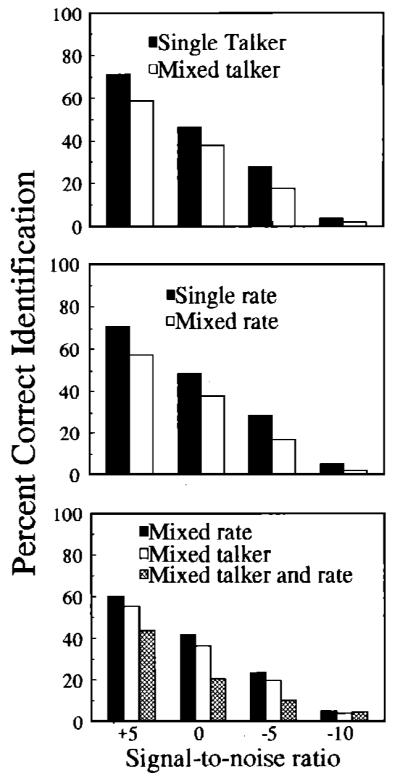
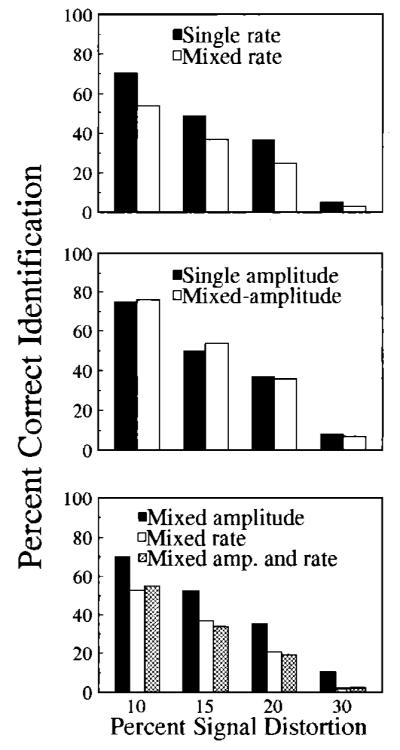
The present experiments investigated how several different sources of stimulus variability within speech signals affect spoken-word recognition. The effects of varying talker characteristics, speaking rate, and overall amplitude on identification performance were assessed by comparing spoken-word recognition scores for contexts with and without variability along a specified stimulus dimension. Identification scores for word lists produced by single talkers were significantly better than for the identical items produced in multiple-talker contexts. Similarly, recognition scores for words produced at a single speaking rate were significantly better than for the corresponding mixed-rate condition. Simultaneous variations in both speaking rate and talker characteristics produced greater reductions in perceptual identification scores than variability along either dimension alone. In contrast, variability in the overall amplitude of test items over a 30-dB range did not significantly alter spoken-word recognition scores. The results provide evidence for one or more resource-demanding normalization processes which function to maintain perceptual constancy by compensating for acoustic-phonetic variability in speech signals that can affect phonetic identification.
本实验研究了语音信号中几种不同的刺激变异性来源如何影响口语单词识别。通过比较沿特定刺激维度存在和不存在变异性的语境下的口语单词识别分数,评估了说话者特征、语速和总体振幅变化对识别性能的影响。单说话者生成的单词列表的识别分数显著高于多说话者语境中生成的相同项目的识别分数。同样,以单一语速生成的单词的识别分数显著高于相应的混合语速条件。语速和说话者特征同时变化导致的感知识别分数下降幅度大于单独一个维度的变异性。相比之下,测试项目在30分贝范围内的总体振幅变化并未显著改变口语单词识别分数。这些结果为一个或多个需要资源的归一化过程提供了证据,这些过程通过补偿语音信号中可能影响语音识别的声学语音变异性来维持感知恒常性。