Kieferle S, Fong P, Bens M, Vandewalle A, Jentsch T J
Centre for Molecular Neurobiology (ZMNH), Hamburg University, Germany.
Proc Natl Acad Sci U S A. 1994 Jul 19;91(15):6943-7. doi: 10.1073/pnas.91.15.6943.
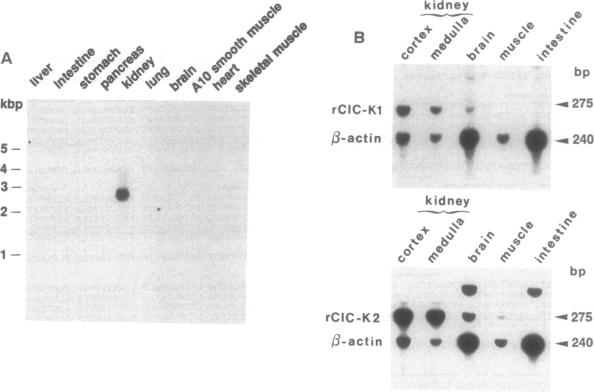
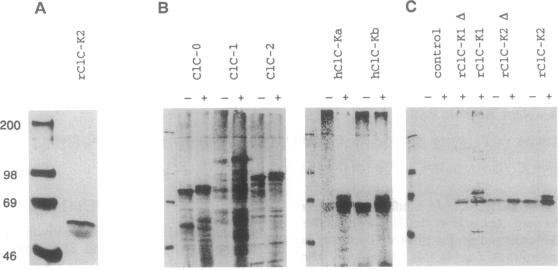
We have cloned two closely related putative Cl- channels from both rat kidney (designated rClC-K1 and rClC-K2) and human kidney (hClC-Ka and hClC-Kb) by sequence homology to the ClC family of voltage-gated Cl- channels. While rClC-K1 is nearly identical to ClC-K1, a channel recently isolated by a similar strategy, rClC-K2 is 80% identical to rClC-K1 and is encoded by a different gene. hClC-Ka and hClC-Kb show approximately 90% identity, while being approximately 80% identical to the rat proteins. All ClC-K gene products are expressed predominantly in the kidney. While rClC-K1 is expressed strongly in the cortical thick ascending limb and the distal convoluted tubule, with minor expression in the S3 segment of the proximal tubule and the cortical collecting tubule, rClC-K2 is expressed in all segments of the nephron examined, including the glomerulus. Since they are related more closely to each other than to the rat proteins, hClC-Ka and hClC-Kb cannot be regarded as strict homologs of rClC-K1 or rClC-K2. After injection of ClC-K cRNAs into oocytes, corresponding proteins were made and glycosylated, though no additional Cl- currents were detectable. Glycosylation occurs between domains D8 and D9, leading to a revision of the transmembrane topology model for ClC channels.
我们通过与电压门控氯离子通道的ClC家族进行序列同源性分析,从大鼠肾脏(命名为rClC-K1和rClC-K2)和人类肾脏(hClC-Ka和hClC-Kb)中克隆出了两个密切相关的假定氯离子通道。虽然rClC-K1与最近通过类似策略分离出的通道ClC-K1几乎完全相同,但rClC-K2与rClC-K1有80%的同一性,且由不同的基因编码。hClC-Ka和hClC-Kb显示出约90%的同一性,而与大鼠蛋白质的同一性约为80%。所有ClC-K基因产物主要在肾脏中表达。rClC-K1在皮质厚升支和远曲小管中强烈表达,在近端小管的S3段和皮质集合小管中有少量表达,而rClC-K2在所检测的肾单位各段中均有表达,包括肾小球。由于hClC-Ka和hClC-Kb彼此之间的关系比与大鼠蛋白质的关系更密切,因此不能将它们视为rClC-K1或rClC-K2的严格同源物。将ClC-K的cRNA注射到卵母细胞中后,相应的蛋白质得以合成并进行了糖基化修饰,尽管未检测到额外的氯离子电流。糖基化发生在结构域D8和D9之间,这导致了对ClC通道跨膜拓扑模型的修正。