Wolz C, Hohloch K, Ocaktan A, Poole K, Evans R W, Rochel N, Albrecht-Gary A M, Abdallah M A, Döring G
Department of General and Environmental Hygiene, University of Tübingen, Germany.
Infect Immun. 1994 Sep;62(9):4021-7. doi: 10.1128/iai.62.9.4021-4027.1994.
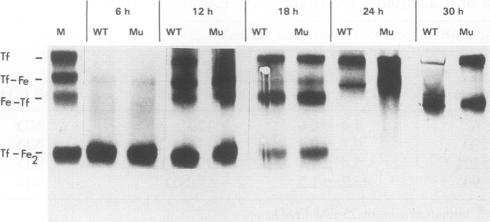
Pseudomonas aeruginosa produces the siderophores pyoverdin and pyochelin as well as receptors for siderophores in response to iron deprivation. Previously, it has been shown in vitro that at neutral pH purified pyoverdin acquires iron from transferrin only in the presence of P. aeruginosa elastase (LasB), which proteolytically degrades transferrin. We constructed a LasB-negative mutant, PAO1E, by insertional mutagenesis to investigate whether this mutant differs in growth from the parental strain PAO1 in an iron-depleted medium supplemented with transferrin or human serum. PAO1 and PAO1E did not differ in growth with 1.25 microM Fe2-transferrin as the only iron source. Urea gel electrophoresis indicated iron release from intact transferrin during the logarithmic growth phase of PAO1 and PAO1E. A total of 333 microM LasB was synthesized from PAO1 after onset of stationary-phase growth. Quantification of pyoverdin by spectroscopy revealed that up to 900 microM pyroverdin was produced during growth of the strains in medium supplemented with Fe2-transferrin or 10% human serum. Incubation of Fe2-transferrin and purified pyoverdin in concentrations similar to those found in the culture supernatant resulted in release iron from transferrin after 10 h at 37 degrees C. However, LasB significantly enhanced the rate constant for iron acquisition of pyoverdin from transferrin. We conclude that P. aeruginosa can use transferrin as an iron source without further need of LasB or pH changes. This is further supported by experiments with P. aeruginosa K437, which has a defective iron uptake system, and its LasB-negative mutant, K437E. Though K437 and K437E did not differ in growth with Fe2-transferrin as the only iron source, their growth was significantly reduced relative to that of PAO1 and PAO1E.
铜绿假单胞菌在铁缺乏时会产生铁载体绿脓菌素和焦磷酸铁以及铁载体受体。此前已在体外表明,在中性pH条件下,纯化的绿脓菌素仅在铜绿假单胞菌弹性蛋白酶(LasB)存在时才能从转铁蛋白获取铁,LasB可通过蛋白水解作用降解转铁蛋白。我们通过插入诱变构建了一个LasB阴性突变体PAO1E,以研究该突变体在补充了转铁蛋白或人血清的缺铁培养基中与亲本菌株PAO1的生长是否存在差异。以1.25微摩尔/升的Fe2 - 转铁蛋白作为唯一铁源时,PAO1和PAO1E的生长没有差异。尿素凝胶电泳表明,在PAO1和PAO1E的对数生长期,完整的转铁蛋白会释放铁。在稳定期生长开始后,PAO1合成了总共333微摩尔的LasB。通过光谱法对绿脓菌素进行定量分析发现,在补充了Fe2 - 转铁蛋白或10%人血清的培养基中培养菌株时,会产生高达900微摩尔的焦绿脓菌素。将Fe2 - 转铁蛋白与纯化的绿脓菌素以与培养上清液中相似的浓度进行孵育,在37℃下孵育10小时后,转铁蛋白会释放铁。然而,LasB显著提高了绿脓菌素从转铁蛋白获取铁的速率常数。我们得出结论,铜绿假单胞菌可以利用转铁蛋白作为铁源,而无需LasB或pH变化。这一结论得到了对具有缺陷铁摄取系统的铜绿假单胞菌K437及其LasB阴性突变体K437E的实验进一步支持。虽然以Fe2 - 转铁蛋白作为唯一铁源时,K437和K437E的生长没有差异,但它们的生长相对于PAO1和PAO1E显著降低。