Jones C H, Pinkner J S, Nicholes A V, Slonim L N, Abraham S N, Hultgren S J
Department of Molecular Microbiology, Washington University School of Medicine, St. Louis, MO 63110.
Proc Natl Acad Sci U S A. 1993 Sep 15;90(18):8397-401. doi: 10.1073/pnas.90.18.8397.
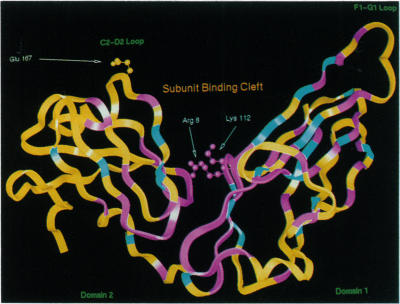
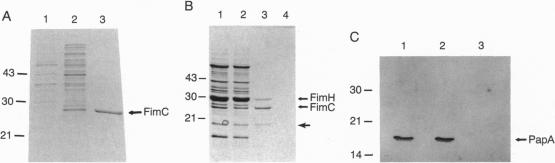
Biogenesis of the type 1 pilus fiber in Escherichia coli requires the product of the fimC locus. We have demonstrated that FimC is a member of the periplasmic chaperone family. The deduced primary sequence of FimC shows a high degree of homology to PapD and fits well with the derived consensus sequence for periplasmic chaperones, predicting that it has an immunoglobulin-like topology. The chaperone activity of FimC was demonstrated by purifying a complex that FimC forms with the FimH adhesion. A fimC1 null allele could be complemented by the prototype member of the chaperone superfamily, PapD, resulting in the production of adhesive type 1 pili. The general mechanism of action of members of the chaperone superfamily was demonstrated by showing that the ability of PapD to assemble both P and type 1 pili was dependent on an invariant arginine residue (Arg-8), which forms part of a conserved subunit binding site in the cleft of PapD. We suggest that the conserved cleft is a subunit binding feature of all members of this protein family. These studies point out the general strategies used by Gram-negative bacteria to assemble adhesins into pilus fibers, allowing them to promote attachment to eukaryotic receptors.
大肠杆菌中1型菌毛纤维的生物合成需要fimC基因座的产物。我们已经证明FimC是周质伴侣蛋白家族的成员。推导的FimC一级序列与PapD具有高度同源性,并且与推导的周质伴侣蛋白共有序列非常匹配,预测它具有免疫球蛋白样拓扑结构。通过纯化FimC与FimH黏附素形成的复合物,证明了FimC的伴侣活性。fimC1无效等位基因可以被伴侣蛋白超家族的原型成员PapD互补,从而产生黏附性1型菌毛。通过显示PapD组装P菌毛和1型菌毛的能力取决于一个不变的精氨酸残基(Arg-8),该残基是PapD裂隙中保守亚基结合位点的一部分,证明了伴侣蛋白超家族成员的一般作用机制。我们认为保守的裂隙是该蛋白家族所有成员的亚基结合特征。这些研究指出了革兰氏阴性菌将黏附素组装成菌毛纤维以促进其与真核受体结合的一般策略。