Watkins S, Madison J, Galliano M, Minchiotti L, Putnam F W
Department of Biology, Indiana University, Bloomington 47405.
Proc Natl Acad Sci U S A. 1994 Mar 15;91(6):2275-9. doi: 10.1073/pnas.91.6.2275.
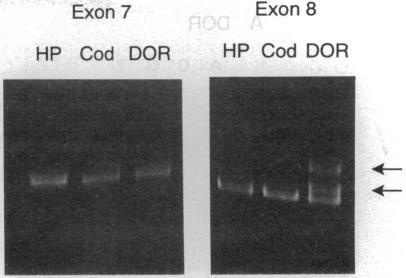
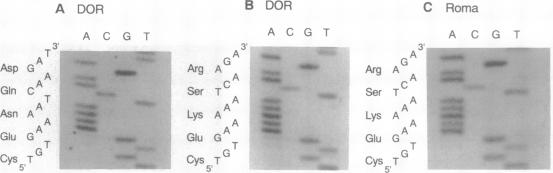
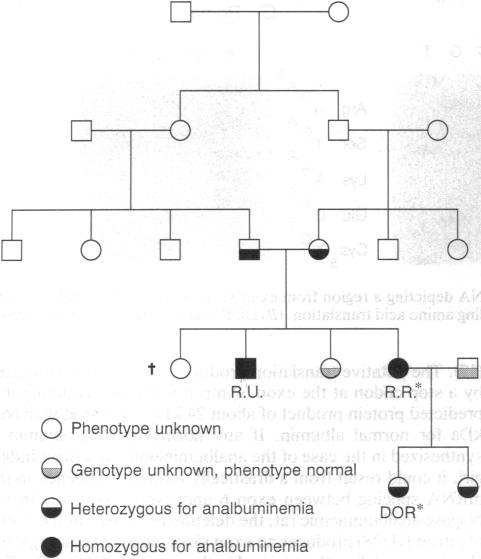
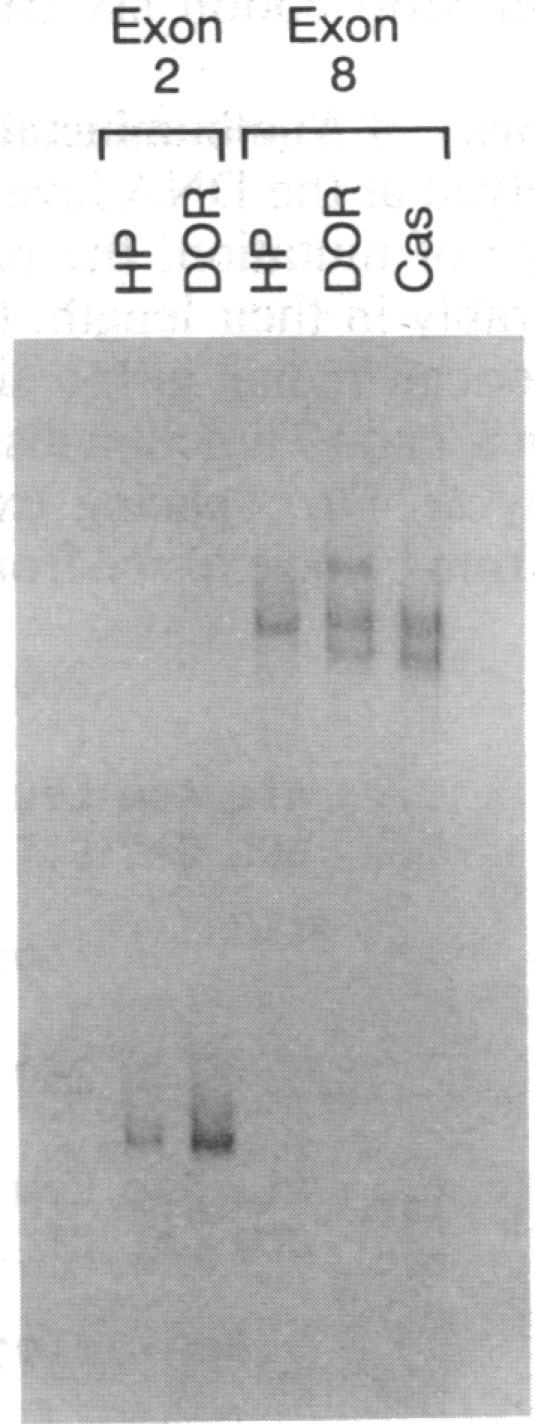
In analbuminemia, a very rare inherited syndrome, subjects produce little or no albumin (1/100th to 1/1000th normal), presumably because of a mutation in the albumin gene; yet, they have only moderate edema and few related symptoms owing to a compensatory increase in other plasma proteins. Because of the virtual absence of albumin the defect must be identified at the DNA level. In this study the mutation causing analbuminemia in an Italian family was investigated by analysis of DNA from a mother and her daughter. The mother was homozygous for the trait and had a serum albumin value of < 0.01 g/dl (about 1/500th normal); the daughter was heterozygous for the trait and had a nearly normal albumin value. Molecular cloning and sequence analysis of DNA from both mother and daughter showed that the mutation is caused by a nucleotide insertion in exon 8; this produces a frameshift leading to a premature stop, seven codons downstream. The methods of heteroduplex hybridization and single-strand conformation polymorphism were used to compare the DNA of the mother and daughter to the DNA of two unrelated analbuminemic individuals (one Italian and one American). This showed that all three analbuminemic individuals had different mutations; these also differed from the mutation in the only human case previously studied at the DNA level, which was a splicing defect affecting the ligation of the exon 6-exon 7 sequences. Thus, analbuminemia may result from a variety of mutations and is genetically heterogeneous.
在无白蛋白血症(一种非常罕见的遗传性综合征)中,患者产生很少或几乎不产生白蛋白(为正常水平的1/100至1/1000),推测是由于白蛋白基因突变所致;然而,由于其他血浆蛋白的代偿性增加,他们仅有中度水肿且相关症状较少。由于几乎不存在白蛋白,必须在DNA水平鉴定该缺陷。在本研究中,通过分析一位母亲及其女儿的DNA,对一个意大利家族中导致无白蛋白血症的突变进行了研究。母亲为该性状的纯合子,血清白蛋白值<0.01 g/dl(约为正常水平的1/500);女儿为该性状的杂合子,白蛋白值接近正常。对母亲和女儿的DNA进行分子克隆和序列分析表明,该突变是由外显子8中的一个核苷酸插入引起的;这导致移码,在下游七个密码子处产生一个过早的终止密码子。采用异源双链杂交和单链构象多态性方法,将母亲和女儿的DNA与两名无关的无白蛋白血症个体(一名意大利人和一名美国人)的DNA进行比较。结果表明,所有三名无白蛋白血症个体都有不同的突变;这些突变也与之前在DNA水平研究的唯一一例人类病例中的突变不同,后者是一个影响外显子6-外显子7序列连接的剪接缺陷。因此,无白蛋白血症可能由多种突变引起,且具有遗传异质性。