Flemington E K, Lytle J P, Cayrol C, Borras A M, Speck S H
Division of Tumor Virology, Dana-Farber Cancer Institute, Harvard Medical School, Boston, Massachusetts 02115.
Mol Cell Biol. 1994 May;14(5):3041-52. doi: 10.1128/mcb.14.5.3041-3052.1994.
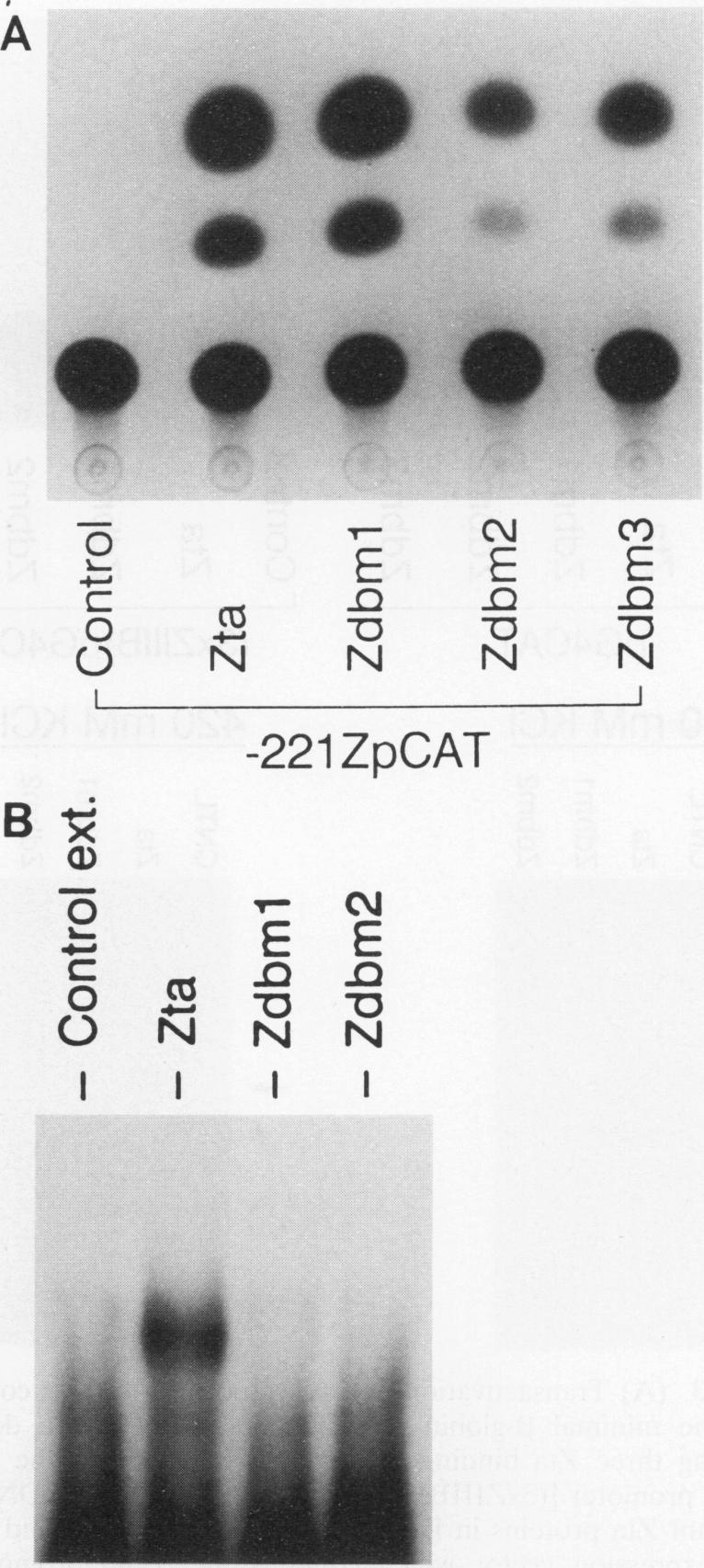
The Epstein-Barr virus BRLF1 and BZLF1 genes are the first viral genes transcribed upon induction of the viral lytic cycle. The protein products of both genes (referred to here as Rta and Zta, respectively) activate expression of other viral genes, thereby initiating the lytic cascade. Among the viral antigens expressed upon induction of the lytic cycle, however, Zta is unique in its ability to disrupt viral latency; expression of the BZLF1 gene is both necessary and sufficient for triggering the viral lytic cascade. We have previously shown that Zta can activate its own promoter (Zp), through binding to two Zta recognition sequences (ZIIIA and ZIIIB). Here we describe mutant Zta proteins that do not bind DNA (referred to as Zta DNA-binding mutants [Zdbm]) but retain the ability to transactivate Zp. Consistent with the inability of these mutants to bind DNA, transactivation of Zp by Zdbm is not dependent on the Zta recognition sequences. Instead, transactivation by Zdbm is dependent upon promoter elements that bind cellular factors. An examination of other viral and cellular promoters identified promoters that are weakly responsive or unresponsive to Zdbm. An analysis of a panel of artificial promoters containing one copy of various promoter elements demonstrated a specificity for Zdbm activation that is distinct from that of Zta. These results suggest that non-DNA-binding forms of some transactivators retain the ability to transactivate specific target promoters without direct binding to DNA.
爱泼斯坦-巴尔病毒的BRLF1和BZLF1基因是病毒裂解周期诱导后最早转录的病毒基因。这两个基因的蛋白质产物(此处分别称为Rta和Zta)激活其他病毒基因的表达,从而启动裂解级联反应。然而,在裂解周期诱导后表达的病毒抗原中,Zta在破坏病毒潜伏方面具有独特能力;BZLF1基因的表达对于触发病毒裂解级联反应既是必要的也是充分的。我们之前已经表明,Zta可以通过与两个Zta识别序列(ZIIIA和ZIIIB)结合来激活其自身启动子(Zp)。在此我们描述了不结合DNA的突变Zta蛋白(称为Zta DNA结合突变体[Zdbm]),但它们保留了反式激活Zp的能力。与这些突变体无法结合DNA一致,Zdbm对Zp的反式激活不依赖于Zta识别序列。相反,Zdbm的反式激活依赖于结合细胞因子的启动子元件。对其他病毒和细胞启动子的检查确定了对Zdbm反应较弱或无反应的启动子。对一组包含各种启动子元件一个拷贝的人工启动子的分析表明,Zdbm激活具有特异性,与Zta不同。这些结果表明,一些反式激活因子的非DNA结合形式保留了反式激活特定靶启动子的能力,而无需直接结合DNA。