Winkler M, Rice S A, Stamminger T
Institut für Klinische und Molekulare Virologie, Universität Erlangen-Nürnberg, Germany.
J Virol. 1994 Jun;68(6):3943-54. doi: 10.1128/JVI.68.6.3943-3954.1994.
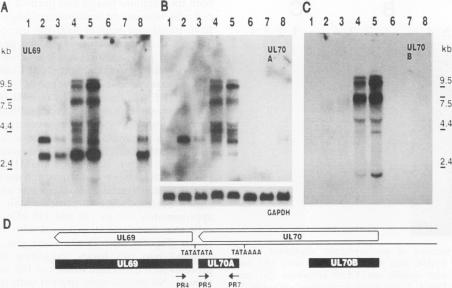
The UL69 open reading frame of human cytomegalovirus (HCMV) is homologous to the immediate-early protein ICP27 of herpes simplex virus, an essential viral regulatory protein involved in the transition from early to late gene expression. Genes with homology to ICP27 have been detected in all subclasses of herpesviruses so far. While the respective proteins in alpha- and gammaherpesviruses have been defined as trans-regulatory molecules, nothing is known about these genes in betaherpesviruses. This study was therefore undertaken in order to investigate expression from the UL69 gene locus of HCMV. Northern (RNA) blot experiments revealed a complex pattern of transcripts that changed during the time course of the HCMV replicative cycle: two transcripts of 2.7 and 3.5 kb that were regulated differentially could be detected as early as 7 h after infection. However, these transcripts could not be detected in the presence of cycloheximide. Additional, larger transcripts were present exclusively at late times after infection. To analyze protein expression from the UL69 gene region, the UL69 open reading frame was expressed as a histidine-tagged protein in Escherichia coli. A specific antiserum was generated and used to detect the UL69 protein in HCMV-infected cells which revealed its localization within the intranuclear inclusions that are characteristic for HCMV infection. In cotransfection experiments, an HCMV true late promoter could not be activated by UL69, whereas an early promoter and several heterologous promoters were stimulated about 10-fold. Complementation studies showed that the UL69 protein cannot substitute for ICP27 in the context of the HSV infection, suggesting functional differences between these two proteins. In summary, these experiments define a novel regulatory protein encoded by HCMV that is expressed as an early-late gene and appears to exert a broad stimulatory effect on gene expression.
人类巨细胞病毒(HCMV)的UL69开放阅读框与单纯疱疹病毒的立即早期蛋白ICP27同源,ICP27是一种参与从早期基因表达向晚期基因表达转变的重要病毒调节蛋白。迄今为止,在疱疹病毒的所有亚类中均检测到与ICP27具有同源性的基因。虽然α疱疹病毒和γ疱疹病毒中的相应蛋白已被定义为反式调节分子,但关于β疱疹病毒中的这些基因却一无所知。因此,开展本研究以调查HCMV的UL69基因座的表达情况。Northern(RNA)印迹实验揭示了在HCMV复制周期过程中发生变化的复杂转录本模式:早在感染后7小时就能检测到两种差异调节的2.7 kb和3.5 kb转录本。然而,在存在环己酰亚胺的情况下无法检测到这些转录本。另外,更大的转录本仅在感染后的晚期出现。为了分析来自UL69基因区域的蛋白表达,将UL69开放阅读框在大肠杆菌中表达为组氨酸标签蛋白。制备了特异性抗血清并用于检测HCMV感染细胞中的UL69蛋白,结果显示其定位于HCMV感染特有的核内包涵体中。在共转染实验中,UL69无法激活HCMV真正的晚期启动子,而早期启动子和几个异源启动子受到约10倍的刺激。互补研究表明,在HSV感染的背景下,UL69蛋白不能替代ICP27,这表明这两种蛋白之间存在功能差异。总之,这些实验确定了一种由HCMV编码的新型调节蛋白,该蛋白作为早期-晚期基因表达,并且似乎对基因表达具有广泛的刺激作用。